Last checked: July 24, 2026
Disclosure: KR Guide Info is independent and not affiliated with Korea Meteorological Administration, Safe Korea, airports, rail operators, hotels, or transport companies. This guide is for travel planning, not emergency instruction. In a real warning or emergency, follow official Korean government, local authority, airport, railway, airline, hotel, and venue instructions first. There are no paid affiliate links in this article.
Quick answer
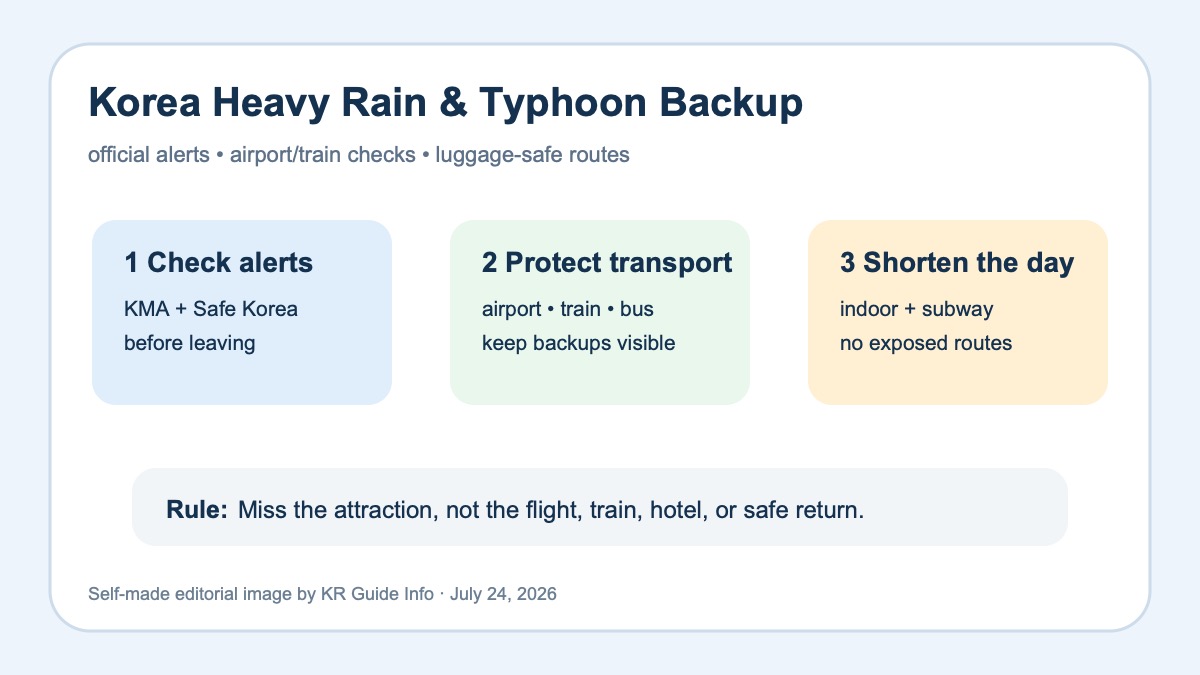
If a typhoon, heavy rain warning, flooded street, or severe thunderstorm affects your Korea trip, do not try to “win” the itinerary. Switch to a transport-first backup plan: confirm official alerts, protect your airport/train connection, avoid exposed coastal or mountain routes, keep luggage close to your hotel or station, and choose indoor plans near subway lines or taxi-accessible areas.
The safest traveler mindset is simple: arrive dry, connected, and with a next transport option. A missed attraction is recoverable. A missed international flight, stranded luggage transfer, or flooded late-night taxi search is much harder.
Use this decision table first
| Weather problem | Best first move | Safer itinerary choice | Avoid |
|---|---|---|---|
| Typhoon forecast for your city | Check official alerts and airline/train notices before leaving lodging | Indoor district near your hotel or a major subway station | Coastal viewpoints, ferries, mountain trails, tight transfers |
| Heavy rain during city sightseeing | Shorten the day and move toward a transport hub | Museum, mall, cafe, market area with covered access | Long bus-only routes through unfamiliar neighborhoods |
| Airport departure day | Move earlier than normal and keep luggage with you | Airport railroad/bus/taxi decision based on official operation status | Last-minute shopping far from the airport line |
| KTX or train disruption risk | Check official rail status and keep bus/flight/hotel backups visible | Later same-day buffer or extra night near the departure city | One final connection with no recovery time |
| Busan/coastal travel day | Reconsider beaches, islands, and exposed coastal walks | Station-area food, indoor attraction, short taxi route | Forcing a day trip just because it was planned |
Step 1: separate inconvenience from real disruption
Korea can handle normal rain well, but heavy-rain systems and typhoons change the risk profile quickly. Do not rely only on a generic weather app from your home country. Use official Korean sources and then confirm with transport operators.
- Normal rain: umbrella, waterproof shoes, slower walking, and subway-centered sightseeing may be enough.
- Heavy rain advisory/warning: avoid streams, underpasses, steep alleys, coastal walkways, and transfers with long outdoor gaps.
- Typhoon watch/warning: expect flight, ferry, event, coastal, and outdoor-attraction disruption. Hotel and transport timing become the priority.
- Localized flooding: map estimates may become unreliable. Ask hotel staff or station staff before committing to a route.
Step 2: protect airport and intercity transport first
When weather worsens, your most valuable item is not the attraction ticket. It is your next confirmed transport link. If you have an airport transfer, KTX, SRT, express bus, ferry, or domestic flight, check that first.
| Next connection | What to check | Practical buffer |
|---|---|---|
| International flight | Airline status, airport access route, check-in timing | Move toward the airport earlier than a normal clear-weather day |
| Domestic flight | Weather at both departure and arrival airports | Prepare a same-day rail/bus or hotel backup if cancellation risk rises |
| KTX/SRT/intercity train | Official rail notices and station departure board | Do not schedule the last possible train if weather is worsening |
| Express/intercity bus | Terminal access, highway conditions, and arrival-city weather | Keep a rail or hotel backup visible for long-distance moves |
| Ferry/island trip | Operator notice and marine weather | Be ready to cancel; do not treat ferries like subway lines |
If your route involves Busan, review the late-arrival Busan backup guide and Gimhae Airport to Busan Station transfer guide before choosing a late, weather-dependent transfer.
Step 3: choose weather-safe city movement
Subway-first plans are usually easier to recover than bus-only or long-walk plans during heavy rain. Taxis can help, but demand may rise, pickup points may be confusing, and traffic can slow down. Do not assume a taxi app will solve everything at the exact moment everyone else wants a taxi.
- Favor subway lines with short indoor or covered walks at both ends.
- Save your hotel address, destination, and nearest station in Korean.
- Keep a power bank accessible, not buried in luggage.
- Carry a plastic bag or pouch for passport, wallet, spare socks, and electronics.
- If you are tired, wet, or low on phone battery, end the day earlier.
For general routing backups, connect this guide with the Korea late-night transport backup guide and the Korea train delay and cancellation backup guide.
Luggage rules during heavy rain
Large luggage turns a wet day into a fragile day. Rolling suitcases do badly with puddles, stairs, crowded buses, and station detours. If you are changing cities during a storm window, simplify the move before you simplify the sightseeing.
- Ask whether your hotel can hold luggage until the weather window improves.
- Use station lockers only after confirming location, size, and payment method.
- Do not leave luggage in a place that requires an exposed return walk during the strongest rain.
- If the next city is optional, consider staying one more night rather than forcing a risky transfer.
For storage decisions, use the Korea coin lockers and luggage storage guide.
Safer itinerary swaps by city type
| Original plan | Weather-safe swap | Why it is safer |
|---|---|---|
| Seoul palace + hillside neighborhoods | Museum, department store food hall, subway-linked cafe district | Less exposed walking and easier subway recovery |
| Busan beach/coastal walk | Centum City, station-area food, indoor market sections, short taxi route | Coastal wind and slippery paths can become the main risk |
| Gyeongju outdoor ruins day | Shorten the day or choose indoor/near-station stops | Long outdoor walking is not worth it in severe rain |
| Jeju or island/ferry plan | Check cancellation notices and prepare hotel/airport backup | Marine and flight disruption can cascade |
| DMZ, mountain, or festival plan | Follow operator/local cancellation notices | Outdoor group activities often change first |
What to pack in a rain/typhoon day bag
- Compact umbrella or rain jacket that can handle wind better than a weak umbrella.
- Waterproof pouch for passport, cards, cash, and phone.
- Power bank and charging cable.
- Spare socks or small towel for long travel days.
- Offline screenshots: hotel address, airport/train booking, nearest station, emergency contacts.
- Small cash backup for places where your foreign card or app fails.
Official sources to check
- Korea Meteorological Administration for official Korea weather information.
- Safe Korea for disaster and safety information.
- Incheon Airport English site for airport information and notices.
- Korail for railway operator information and service notices.
Related KR Guide Info guides
FAQ
Should I cancel sightseeing during a typhoon in Korea?
If an official typhoon warning affects your area, treat outdoor sightseeing as optional and transport safety as essential. Follow local authority, hotel, airport, rail, and venue instructions.
Are subways better than taxis in heavy rain?
Often yes for predictable movement, but it depends on the route and station access. Taxis may face high demand and traffic, while subways require walking to and from stations.
Can I still travel between Seoul and Busan in heavy rain?
Sometimes yes, but check official rail or airline notices and avoid last-connection plans. Keep hotel and alternate transport options visible until the trip is confirmed.
What should I do if my flight or train is cancelled?
Contact the operator through official channels, keep all booking records, and prioritize lodging and onward transport. Do not move far from the relevant airport or station until you know the next available option.
Update log
- July 24, 2026: First draft prepared with Korea weather-alert logic, airport/train disruption backups, subway/taxi/luggage checklists, official source links, and internal links for foreign visitors.