Last checked: June 7, 2026 KST. Busan subway lines, transport-card acceptance, fares, station facilities, event controls, and late-night operation can change. Always confirm final routes on the official Busan Transportation Corporation site or a live map app on your travel day.

Disclosure: This guide is for independent travel planning. It is not affiliated with Busan Transportation Corporation, Busan City, any ticketing company, or any concert organizer. It avoids invented schedules and prices; use the official sources linked near the end for final checks.
Quick answer: what foreign visitors should know first
For most first-time visitors, Busan subway is the simplest way to move between Busan Station, Seomyeon, Haeundae, Gwangalli/Suyeong, Nampo, Sasang, and the Sports Complex area near Busan Asiad Main Stadium. Use a rechargeable Korean transport card when possible, keep a small cash/card backup for charging or single-use tickets, and check the last train before you leave a concert, beach area, or late dinner.
If you are visiting for a major concert, do not treat the subway like a private airport transfer. Expect crowd control, slower station exits, and temporary changes around the venue. Your best strategy is to arrive early, save your hotel route in a map app before the show, and choose a hotel area that gives you a simple subway path rather than the theoretically shortest taxi ride.
Who this guide is for
This guide is written for English-speaking visitors who are new to South Korea and want to use Busan public transport without guessing at ticket machines. It is especially useful if you are combining Busan sightseeing with a stadium concert, a Gimhae Airport arrival, a KTX arrival at Busan Station, or a hotel stay in Seomyeon, Haeundae, Nampo, or Gwangalli.
Busan subway basics in plain English
Busan’s subway network is useful because the main tourist areas are not all close together. Busan Station is convenient for KTX arrivals, Seomyeon is a central transfer and hotel area, Haeundae is on the eastern beach side, Nampo is close to markets and the old downtown, and Sasang connects many travelers toward Gimhae Airport or intercity routes. The Sports Complex area is the part many foreign concert visitors need to understand because it is not the same as Haeundae, Busan Station, or Nampo.
The subway is usually easier than taxis for first-time visitors because station names, line numbers, and transfers are easier to verify in apps. Taxis can be useful late at night or with luggage, but around concerts they may be delayed, expensive, or simply difficult to catch near the venue exit. Plan your subway route first, then keep taxi as a backup rather than your only plan.
First decision: transport card or single-use ticket?
| Option | Best for | What to watch |
|---|---|---|
| Rechargeable transport card | Most visitors using subway and buses more than once | You need enough balance before entering; check whether your card can be topped up at the machine or convenience store you are using. |
| Single-use subway ticket | One short ride, emergency backup, or visitors who cannot charge a card immediately | Slower at busy stations and less convenient if you need multiple transfers or late-night movement. |
| Taxi or ride-hailing backup | Late-night return, heavy luggage, missed last train, or routes not served conveniently by subway | Concert exits and beach nightlife areas can create long waits; save the hotel address in Korean and English. |
Many travelers use the word “T-money” for Korean transport cards in general, but different card brands and tourist cards exist. In practical terms, you want a stored-value transport card that works on local public transport, can be recharged, and is accepted where you are riding. Buy or top up from a reliable channel, keep the card after Seoul if you are continuing to Busan, and do not wait until a crowded stadium station to solve your balance problem.
Step-by-step: how to ride the Busan subway
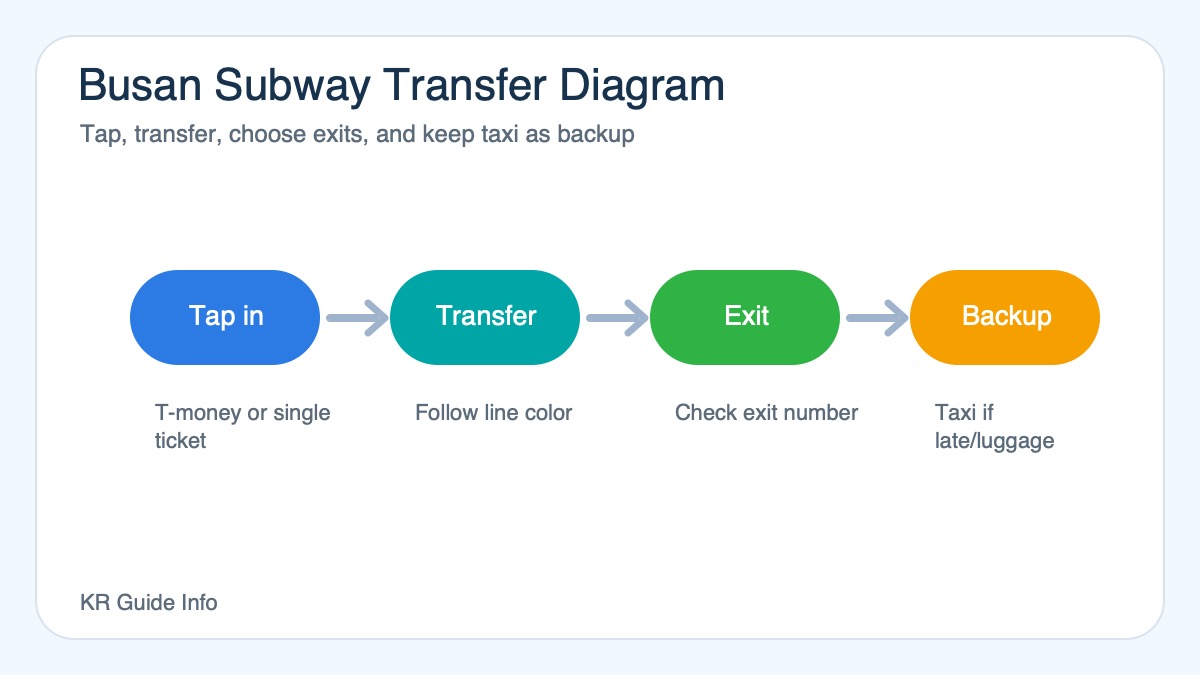
- Search the route before entering the station. Use a Korea-friendly map app and confirm the destination station, line color/number, transfer station, and estimated travel time.
- Check the direction, not only the line number. Many mistakes happen when visitors enter the correct line but board toward the wrong terminal.
- Tap in or buy a single-use ticket. If using a transport card, make sure the gate reads your card and opens. If the balance is low, recharge before you join the platform crowd.
- Follow transfer signs inside the paid area. Some transfers require walking. Do not exit the fare gate unless your app or station sign clearly tells you to.
- Before leaving the train, prepare your exit number. This matters near stadiums, beaches, and markets where the wrong exit can add a long walk.
- Tap out and pause away from the gate. If you need to check your phone, move to the side so you do not block commuters or concert crowds.
Concert visitor strategy: before and after the show
Busan Asiad Main Stadium and the wider Sports Complex area can draw crowds for major events. Even when the official event details are confirmed, transport conditions can still depend on temporary crowd control, ticket pickup, police guidance, and organizer announcements. Treat the subway as your primary “get close and get out safely” tool, not as a guarantee that every station exit will be open exactly as usual.
| Timing | Practical move | Why it helps |
|---|---|---|
| Morning or early afternoon | Charge your transport card and screenshot the route from hotel to venue. | You avoid solving card or app problems when thousands of people are moving. |
| 2–4 hours before showtime | Move toward the venue area earlier than you think necessary. | Ticket checks, merchandise lines, food, toilets, and entry gates can take longer than the subway ride itself. |
| Right after the show | Wait briefly in a safe area or walk toward a less crowded exit if staff direct you. | The first wave can overwhelm gates, stairs, and taxi pickup points. |
| Late evening | Check last-train options before you commit to dinner or drinks far from your hotel. | Missing the last convenient subway can turn a simple night into a difficult taxi search. |
Choosing your Busan base by subway difficulty
If the subway makes you nervous, your hotel area matters more than saving a few minutes on a map. Seomyeon is often the easiest “transport-first” base because it is central and useful for transfers. Busan Station is practical if you arrive or leave by KTX, but it may not be the best nightlife or beach base. Haeundae is attractive for beach stays, but it can make some cross-city movements feel longer. Nampo is good for markets and old downtown sightseeing, while Gwangalli/Suyeong can work well for a beach-and-evening trip if your route is planned.
For concert visitors, avoid choosing a hotel only because it looks geographically close on a map. A hotel with a clean subway path can be less stressful than a “nearby” hotel that leaves you depending on a crowded taxi zone after the show.
Payment, card, and app checklist before you ride
- A rechargeable Korean transport card or a plan to buy single-use tickets.
- A small cash/card backup for recharge problems, lockers, convenience stores, or taxi contingency.
- A Korea-friendly map app such as Naver Map or KakaoMap, with your hotel saved.
- Mobile data through roaming, SIM, or eSIM; station Wi-Fi should not be your only plan.
- Your hotel address saved in English and Korean for taxi drivers or staff assistance.
- A screenshot of your route in case the venue area is crowded or your phone battery is low.
- A portable battery if you are attending an all-day event or concert.
Common mistakes foreign visitors make in Busan
Mistake 1: assuming Busan is small because it is “one city.” Beach areas, KTX arrival points, markets, airport access, and stadium areas can be far apart. Build routes around actual stations and transfers, not only neighborhood names.
Mistake 2: waiting until after a concert to check the last train. If your hotel is across the city, last-train timing matters. Check it before the show starts and decide your backup taxi plan early.
Mistake 3: depending on one payment method. Foreign cards usually work in many places, but transport-card recharge, small shops, and emergency situations can be less predictable. Keep a practical backup.
Mistake 4: ignoring exit numbers. In Korea, exit numbers are part of the route. The correct exit can save time; the wrong exit can place you on the opposite side of a wide road or far from the event entrance.
Simple sample routes to understand the network
Use the examples below as planning patterns, not guaranteed routes. Always confirm your live route in a map app because service changes, construction, and crowd controls can affect the best path.
| Traveler situation | Planning pattern | Backup thought |
|---|---|---|
| Arriving by KTX at Busan Station | Use subway from Busan Station and transfer as needed toward your hotel or venue area. | If carrying large luggage, consider hotel drop-off first instead of dragging bags to a stadium. |
| Staying in Seomyeon | Use Seomyeon as your transfer-friendly base for beaches, markets, and Sports Complex-area movement. | After a concert, check whether returning through the same transfer is still convenient late at night. |
| Staying in Haeundae | Expect longer cross-city movement for some destinations; leave earlier for stadium or KTX connections. | For very early departures, check whether subway timing works or whether a taxi is safer. |
| Arriving at Gimhae Airport | Plan airport-to-city movement before landing and confirm whether your hotel area is easier via rail transfer or taxi. | With heavy luggage or late arrival, taxi may be worth considering even if subway is possible. |
Internal planning links
Use this guide together with these related KR Guide Info articles:
- Gimhae Airport to Busan Guide for First-Time Visitors
- T-money Card Guide for Tourists in Korea
- Best Apps for Traveling in Korea: What Visitors Actually Need
How KR Guide Info checked this guide
This guide was reviewed as a practical Busan subway and T-money use guide for foreign visitors, with the goal of reducing real travel friction rather than adding generic destination description.
- checked the guide around the first ride sequence: card setup, tap-in, transfer, exit number, and taxi fallback
- kept Busan-specific transfer stress separate from general Korea transport advice
- linked nearby Busan arrival and airport guides so readers can connect the subway plan to a real trip route
Official sources to check before travel
- Busan Transportation Corporation / Humetro — subway network and official transit information.
- Busan Metropolitan City English portal — city-level announcements and visitor information.
- Visit Busan — official tourism information for neighborhoods, attractions, and travel planning.
- T-money Korea Tour Card information — tourist transport-card reference; check current details before purchase.
Related KR Guide Info guides
FAQ
Can I use the same transport card in Seoul and Busan?
Many Korean transport cards are designed for broad public-transport use, but card type and recharge channels can vary. If you already used a card in Seoul, test it at the Busan subway gate or recharge machine before a busy travel moment. Do not wait until a concert exit or airport transfer to discover a balance or compatibility problem.
Is Busan subway enough for a concert trip?
For many visitors, yes, it is the best backbone. The weak point is not the normal subway system; it is crowd timing, late-night limits, and the distance between your hotel and the venue area. Plan subway first, then keep a taxi or hotel-area backup for the end of the night.
Should I stay near the stadium or near a subway hub?
For a one-night concert-only trip, a nearby hotel can be convenient if available and fairly priced. For a broader Busan trip, a subway-friendly hub such as Seomyeon or another well-connected area may be less stressful. The right answer depends on whether your main problem is the post-concert exit, airport/KTX connection, or sightseeing time.
What if I miss the last train in Busan?
Move away from the most crowded venue exit, check taxi options, and use your saved Korean hotel address. If you are with friends, stay together until transport is arranged. This is why the safest concert plan is to know your last-train time before the show and keep phone battery available.
Do I need cash for Busan subway?
You may not need much cash for normal shopping, but a small backup is useful for transport-card recharge issues, single-use tickets, lockers, or small purchases. Foreign cards can be convenient, yet a backup payment method reduces stress when machines or stores do not behave as expected.
Update log
- June 7, 2026: First draft prepared with Busan subway, transport-card, concert-crowd, hotel-base, and official-source planning checks. Current fares, last trains, and event-specific controls intentionally left for official live verification.
Continue the Busan concert travel cluster
For a smoother Busan stadium trip, use this guide together with the related planning pieces below: