Last checked: June 10, 2026
Quick answer
For most visitors, Korea public transport is easiest when you combine subway or rail for the main route, buses for shorter local gaps, and taxis only as a fallback. Prepare T-money, use Naver Map or Kakao Map, and check the final return route before late evening.
Use the subway as your default in major cities
For most visitors in Seoul and Busan, the subway should be the default starting point. It is usually the most predictable option, avoids road traffic, and makes neighborhood-to-neighborhood movement easier once you learn the map logic.
The key habit is to think in terms of exits and walking distance, not only station names. What looks close on a screenshot can still involve long underground passages, stairways, or a longer surface walk than expected. That is why station planning matters more than tourists often assume.
If you want the city to feel manageable, the subway is usually the backbone that keeps the day coherent.
Use buses when they simplify a known route
Buses are often useful for short hops or routes that avoid awkward subway transfers. The problem is that first-time visitors often try to improvise with buses before understanding the route clearly. That is when they become stressful.
A planned bus route can save time. A guessed bus route usually does not. If you already know the corridor and where you are getting off, buses can be an efficient part of the day. If you do not, the subway is often the lower-stress choice.
- Use buses when they remove one or more awkward subway changes
- Use buses when the route is simple and easy to track
- Prefer the subway when you want maximum predictability
- Keep one fallback route in mind if timing matters
This is why many visitors end up using a hybrid approach: subway as the main system, buses as selective route improvers.
Intercity rail works best for clear city-to-city decisions
KTX and other rail options are valuable when you are traveling between major cities. The important planning question is not whether the train is fast on paper. It is whether the whole door-to-door route is actually simpler than the alternatives.
A rail trip that looks efficient in isolation may still involve luggage handling, station navigation, and last-mile transport that changes the experience. Always judge the full trip, not only the train segment.
This is where route clarity matters more than enthusiasm for trains. If the rail move clearly supports the trip structure, it is a strong option. If it creates more transfer work than value, it may not be worth it.
Airport transfers need a primary plan and a backup
Airport movement is easier when you decide your first transfer before you fly. Choose one main option and one backup. Rail, airport buses, and taxis all have use cases, but the right choice depends on your arrival time, luggage, and hotel location.
If your hotel is near a convenient station, rail may be the cleanest option. If the route from the station to the hotel is awkward after a long-haul flight, a bus or taxi can be worth it even if it looks less elegant on a map.
If you are still choosing between those options, compare this with the Incheon airport stay guide and the Korea arrival checklist.
Paying and moving through the day should feel simple
Before you start moving heavily, know how you will handle transit payments. For many visitors, the simplest approach is to set up one practical local transport method early and use it consistently. That is why T-money and other basic transport setup decisions matter.
Good public transport use in Korea is not about mastering every option. It is about choosing a stable movement system that supports the trip instead of distracting from it. If you can do that, Korea’s transport network starts working for you very quickly.
How transport advice should shape a traveler’s day
How To Use Public Transport In Korea Without Making The Common First-Time Mistakes is most useful when you treat transport as part of the experience rather than as a background technical detail. In Korea, transport quality is high enough that route choices influence how relaxed or rushed the whole day feels. One better movement decision often improves everything that comes after it.
What visitors usually underestimate about moving around Korea
- Choose the most predictable route when the day already has enough complexity
- Build one fallback route when timing matters
- Pay attention to station exits and last-leg walking distance
- Use the “cleanest route” rather than the most ambitious route
How KR Guide Info checked this guide
This guide was reviewed as a practical public transport use guide for foreign visitors, with the goal of reducing real travel friction rather than adding generic destination description.
- checked the advice against the way first-time visitors actually move between subway, buses, intercity rail, airport transfers, and taxis
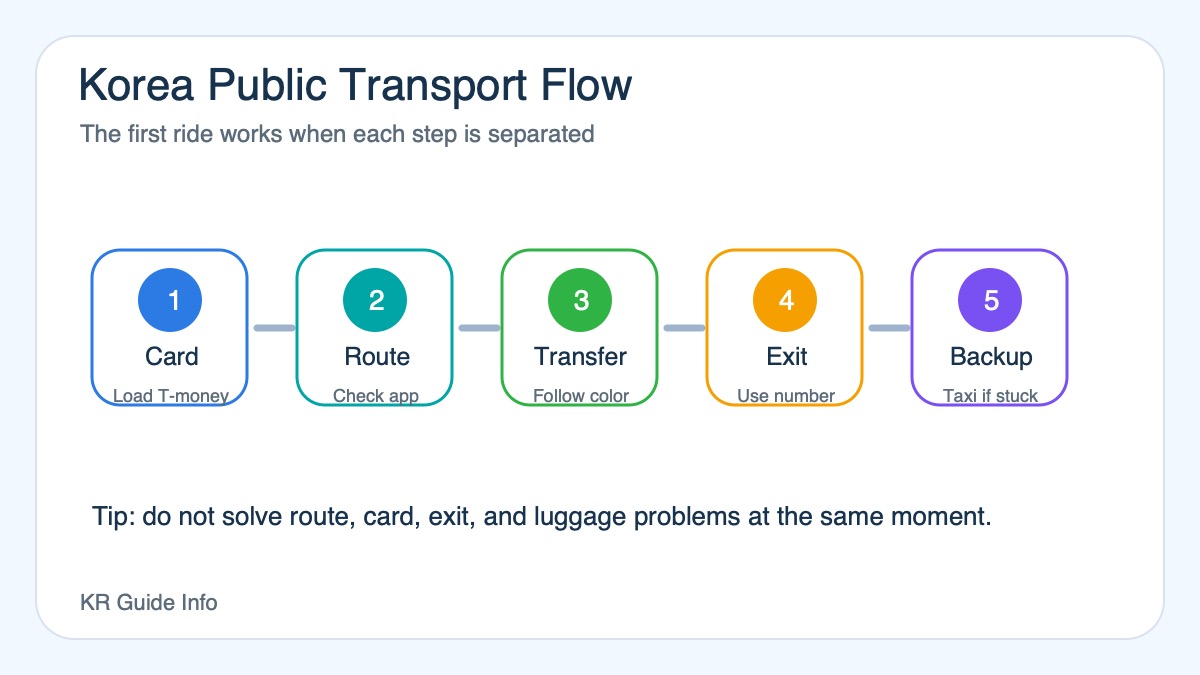
- separated route planning, payment setup, station exits, and fallback transport so readers do not solve everything at once
- kept official transport/source links visible for schedules, rail services, and airport routes that can change
Official sources
- Korea Tourism Organization
- Seoul Metro English site
- Korail official global site
- T-money foreign visitor information
Related KR Guide Info guides
- T Money Card Guide For Tourists In Korea
- Naver Map Vs Kakao Map For Korea Travel
- How To Use Seoul Buses First Time Visitors