Last checked: June 10, 2026
Disclosure: This guide to Korea SIM, eSIM, T-Money, And Payment Guide For Visitors was independently reviewed by KR Guide Info using official and provider information. Clearly marked affiliate links may earn us a commission at no extra cost to you; official-source links are not monetized, and partners had no editorial control.
Quick answer
Most short-term visitors should solve three basics before leaving the airport: mobile data, a transport card, and at least one payment backup. An eSIM is convenient if your phone supports it, but T-money and a backup card or cash reserve still matter for buses, small purchases, and emergencies.
Choose connectivity based on simplicity, not novelty
For many visitors, an eSIM is the cleanest option because it removes one airport task and lets you land with mobile data already prepared. A physical SIM still makes sense when your device setup is limited, when you prefer a visible handoff, or when you simply trust a more familiar process.
The practical question is not which option sounds more advanced. It is whether your phone supports it properly, whether activation is straightforward, and whether you will still have a backup if something goes wrong.
If your setup decision still feels unclear, compare this with the eSIM vs SIM guide. For many travelers, the best choice is the one that removes the most airport friction, not the one with the longest feature list.
Use payment planning to reduce risk, not to chase perfect efficiency
Korea is comfortable for card use in many normal travel situations, but that does not mean you should rely on one card only. Bring at least one backup card and a modest cash reserve for situations where flexibility matters more than ideal theory.
- Carry more than one card
- Enable international use before departure
- Keep a small cash reserve for backup
- Avoid building the whole trip around one payment app or one card network
- Keep one low-friction fallback ready for the first 24 hours
The strongest setup is usually “card first, backup ready,” not blind trust in one payment method. The goal is not to create complexity. The goal is to remove the chance that a minor payment issue turns into a first-day delay.
Understand T-money as a daily travel tool, not a niche add-on
A transport card such as T-money matters because it simplifies repeated movement. The value is not that it is complicated or special. The value is that it removes one more small point of friction from the day when you are using subways and buses regularly.
That matters more than many visitors expect because local transport decisions repeat often. A stable setup creates a steadier travel rhythm. If public transport is part of your itinerary, sorting this out early can improve the entire week.
For a fuller breakdown, compare this with the dedicated T-money guide and the Korea public transport guide.
Cash still has a role even on a card-friendly trip
You do not need to build the whole trip around carrying large amounts of cash, but a modest backup remains sensible. It gives you flexibility for edge cases and reduces stress if your main payment setup does not behave exactly as expected.
The practical question is not whether Korea uses cards. It is how much backup helps you travel more calmly. For most visitors, the answer is “a little, but not a lot.” That is why a modest reserve is usually enough.
If you want a cash-specific framework, combine this article with the Korea cash guide and the foreign card guide.
A clean arrival setup beats a perfect one
A strong Korea setup is not the most complicated one. It is the one that makes the first 24 hours feel stable. That usually means one clear mobile data plan, one clear transport payment plan, and more than one way to pay for everyday purchases.
If those basics are handled, the rest of the trip starts from a much stronger position. In practice, that matters more than shaving tiny amounts of cost or comparing minor feature differences after midnight on the night before the flight.
Why setup details matter more than travelers expect
Korea SIM, eSIM, T-Money, And Payment Guide For Visitors matters because payment, mobile data, and transport setup affect the first 24 hours of a Korea trip almost immediately. These are not glamorous decisions, but they shape how calm the whole arrival and city-learning phase feels. When these basics are stable, the rest of the itinerary usually becomes easier to trust.
That is why strong travel setup is less about chasing the best feature list and more about choosing the arrangement that removes the most failure points.
What backup planning looks like in practice
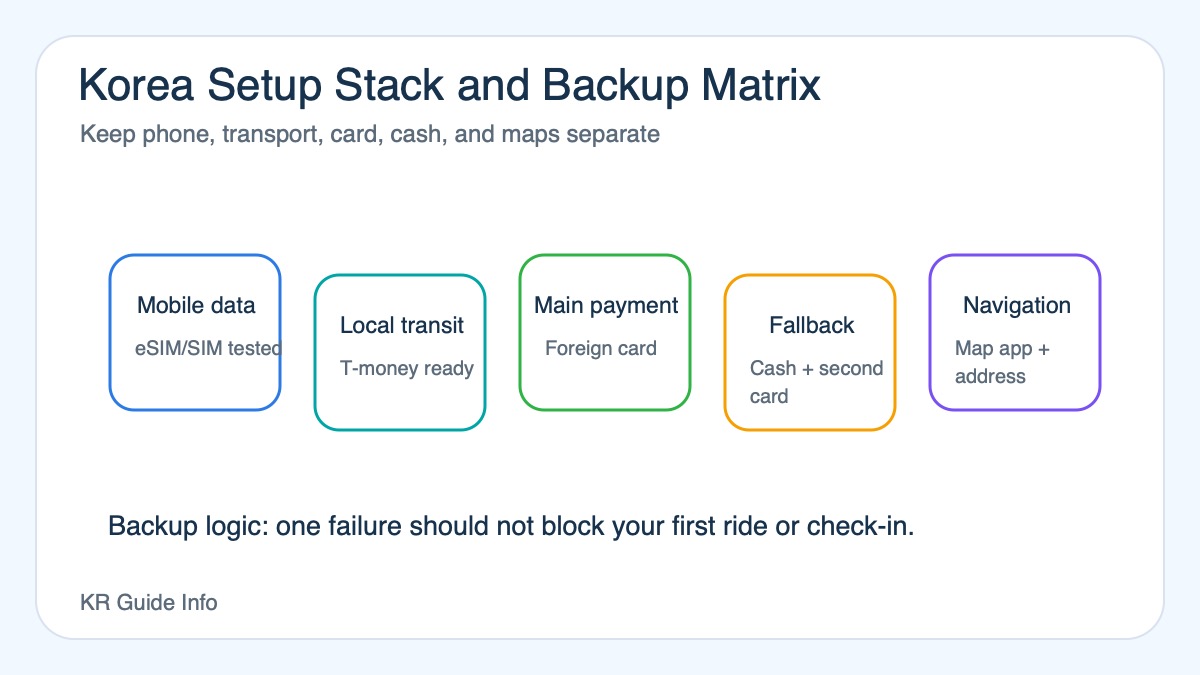
The strongest setup is usually not a single perfect tool. It is a main option plus a backup that is easy to understand. One card plus another card, one data plan plus a fallback, one transport method plus a simple secondary plan. That structure works well because it reduces the cost of minor problems.
- Use the simplest main option you trust
- Keep one backup payment method ready
- Do not delay setup decisions until after landing
- Favor reliability over novelty when the trip is short
How KR Guide Info checked this guide
This guide was reviewed as a practical arrival setup systems guide for foreign visitors, with the goal of reducing real travel friction rather than adding generic destination description.
- reviewed the guide around the sequence travelers face on arrival: mobile data first, transit payment second, then card/cash backup
- kept SIM, eSIM, T-money, and foreign-card advice separated so one failure does not block the rest of the day
- checked that official and provider-facing links remain available for readers before purchase or travel
Official sources
Related KR Guide Info guides
- eSIM vs SIM Card in Korea for Tourists
- T-money Card Guide for Tourists in Korea
- Foreign Card Payments in Korea
Update log
Use these next for payment and daily setup
SIM, transport, and payment choices are connected, so check the practical payment and convenience-store guides before your first day in Korea.
- Foreign card payments in Korea — prepare a realistic card-and-backup setup
- Korea convenience store guide for travelers — understand common small-purchase and travel-errand situations
- How much cash do you need in Korea? — decide how much backup cash is enough
Choose your arrival setup in the right order
Do not buy every Korea travel product at once. Solve connectivity first, then local transport, then payment backup. The right setup depends on your phone, arrival time, and whether you need staff help.
| Your situation | Best starting setup | Backup to prepare |
|---|---|---|
| Unlocked eSIM-compatible phone | Install an eSIM before departure and activate it after landing | Save the QR code offline and know where airport SIM counters are |
| Phone does not support eSIM | Reserve a physical SIM or buy from a staffed airport counter | Keep hotel Wi-Fi details and an offline map screenshot |
| Using foreign cards for most purchases | Carry one primary card, one card on a different network, and a small cash reserve | Load a transit card separately because foreign bank cards do not replace T-money everywhere |
| Late-night arrival | Arrange data before departure and confirm the first transport route | Save the hotel address in Korean and a taxi fallback |
Purchase checkpoint: confirm that your phone is carrier-unlocked, check the provider’s activation window, and compare the total data allowance rather than only the headline price. A cheap plan that cannot be activated at the airport is not a useful saving.
How we evaluated the options: KR Guide Info separated mobile data, transit payment, and retail payment because they fail in different ways. The recommendations were checked against provider setup guidance and official transport information; no single product is presented as the universal answer.
FAQ
Should I prepare an eSIM before arriving in Korea?
If your phone supports eSIM and provider instructions are clear, preparing it before arrival can reduce airport friction. Keep a backup plan.
Do I still need T-money if I have a foreign credit card?
Most travelers should still plan for T-money or a compatible transit card because it simplifies subway and bus use.
How much cash should I carry on arrival?
A small cash backup is useful for older machines, markets, deposits, or unexpected card issues.