Last checked: July 09, 2026. Disclosure: This guide is independent and is not sponsored by Tmoney, WOWPASS, NAMANE, Seoul Metropolitan Government, airport operators, or card issuers. Always confirm current card rules, fees, and service areas on official pages before relying on one card for your whole trip.
Many first-time visitors arrive in Korea with one simple question: Which card should I buy first? The confusing part is that “travel card” can mean three different things in Korea: a transit stored-value card for subway and buses, a prepaid payment card for shops, or a time-based transport pass. The best answer is usually not one universal card. It is a small setup that matches your route, phone situation, and backup-payment needs.
Quick answer: the safest setup for most visitors
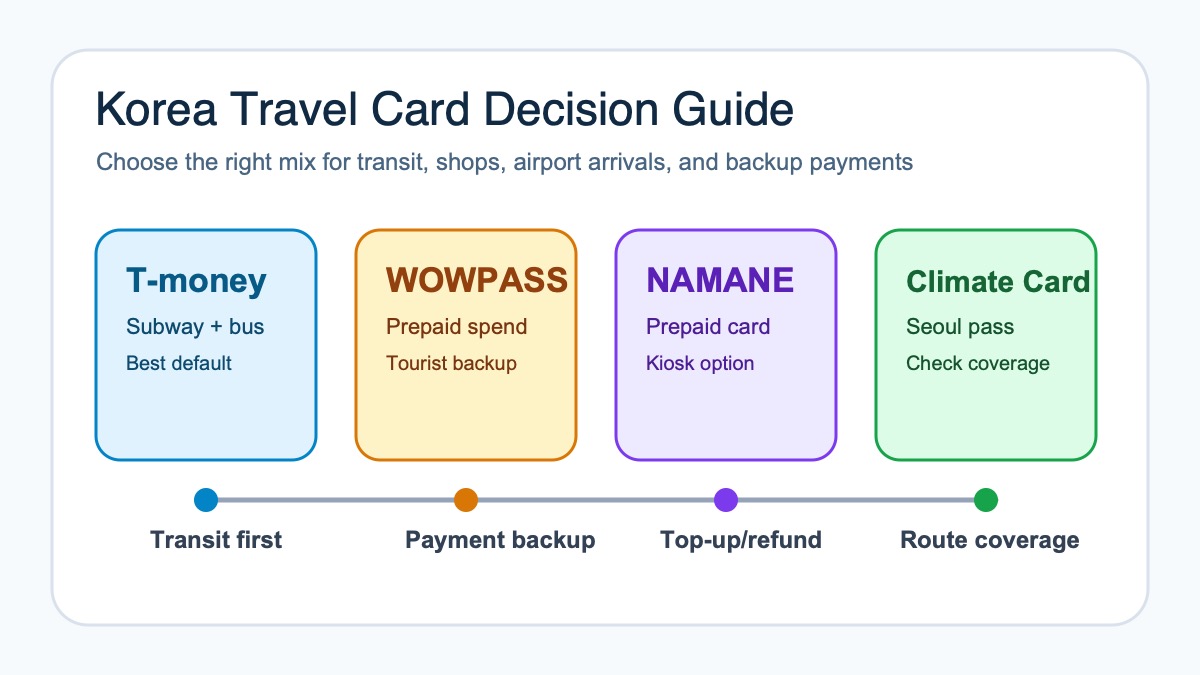
If you want a low-stress setup, use this rule: keep a T-money card for everyday subway and bus rides, use your international Visa/Mastercard wherever it works, and add a prepaid card such as WOWPASS or NAMANE only if you want a Korea-friendly backup for shops, cafés, and small purchases. Consider the Seoul Climate Card only when your itinerary is mostly inside Seoul for enough rides to justify a time-based pass.
| Visitor situation | Best first card | Why it works | Backup to carry |
|---|---|---|---|
| First Korea trip, moving between Seoul/Busan/other cities | T-money | Simple for subway and buses in many areas; easy to understand at convenience stores and stations | International credit card plus some KRW cash |
| Mostly Seoul, many subway/bus rides every day | Check Seoul Climate Card | A time-based pass may beat pay-per-ride if your route is within the covered area | T-money for non-covered transfers or outside-Seoul days |
| Card acceptance worries, no Korean phone number, or cash-heavy arrival | T-money + WOWPASS or NAMANE | Separate transit from shop payments and gives a prepaid fallback | Passport, international card, small cash reserve |
| Short business trip with taxis and hotels | International credit card + T-money | Hotels, larger restaurants, and taxis often take major cards; transit still needs a reliable local transit card | Cash for station machines or convenience-store top-ups |
| Family/group trip | One T-money per rider | Transit gates usually require each person to tap separately | One shared payment card is fine for shops, not subway gates |
What each card is actually good for
T-money: the default transit card
T-money is the safest default if your main problem is getting through subway gates and onto buses. You normally buy or top it up at convenience stores or station machines, then tap in and out on transit. It is not a magic all-purpose tourist wallet: the core reason to carry it is transport reliability. For regional travel, keep in mind that long-distance trains, intercity buses, airport transfers, and some special services may require separate tickets or payment channels.
WOWPASS: prepaid shopping card plus tourist convenience
WOWPASS is popular with visitors because it is designed around foreign tourists, kiosks, currency exchange/top-up flows, and card payment. It can reduce the awkward moment when a foreign-issued card fails at a smaller merchant. It should not replace a transit-first plan: check the current product details, fees, recharge/refund rules, and whether transit features require a separate balance or card function before you depend on it on arrival day.
NAMANE: prepaid card with customizable design and local payment use
NAMANE is another visitor-friendly prepaid card option. It is useful if you want a separate local spending card and like the kiosk/card-issuing flow. As with any prepaid product, the practical questions are not just “Can I pay?” but “Where can I top up, how do refunds work, what happens if the app or kiosk is inconvenient, and does my itinerary actually need this extra card?”
Seoul Climate Card: useful pass, but only for the right geography
The Climate Card is a Seoul-focused transport pass. It can be useful when your accommodation, sightseeing, and daily rides stay inside the covered network. It becomes less attractive when you are doing airport transfers, KTX/SRT, intercity buses, Busan days, Gyeonggi-side accommodation, or routes outside the pass rules. Before buying it, compare your actual rides against the official coverage and current pass conditions.
Airport-arrival decision flow
- Before leaving the airport, decide your first ride. AREX, airport limousine bus, taxi, and domestic flight transfer all have different payment habits. Do not buy a pass just because it is visible at the airport.
- If taking subway/AREX-style rail into the city, secure a transit solution first. A T-money card or the correct rail ticket solves the gate problem faster than a shop-payment card.
- If arriving late at night, prioritize certainty over optimization. A taxi or late airport bus may be safer than trying to understand a new pass when counters are closed.
- Keep small KRW cash if possible. It protects you when a kiosk refuses a foreign card, a top-up is cash-only, or your phone battery dies.
- Do not put every plan into one app. Screenshot your hotel address in Korean and English, keep your passport accessible, and save official transport pages offline.
Cost logic: when a pass beats pay-per-ride
A time-based pass is only valuable when it matches both where you travel and how often you ride. A visitor staying near Myeongdong, Hongdae, or Seoul Station and making several subway/bus hops per day may get more value from a Seoul-focused pass than a visitor who spends one day in Seoul, one day on KTX, and two days in Busan. For mixed-city itineraries, the simplest cost-control strategy is often pay-per-ride transit plus separate long-distance tickets.
| Trip pattern | Card strategy | Common mistake to avoid |
|---|---|---|
| 3 nights Seoul only, dense sightseeing | Compare Seoul Climate Card rules against a T-money pay-per-ride plan | Assuming airport or outside-Seoul legs are covered without checking |
| Seoul + Busan by KTX | T-money for city transit; separate Korail ticket; optional prepaid shop card | Thinking one city transit card handles intercity rail tickets |
| Busan-focused trip | T-money or local-compatible transit card; normal card/cash backup | Buying a Seoul-specific pass for a Busan itinerary |
| Shopping-heavy trip | T-money for transit plus WOWPASS/NAMANE if foreign-card failures worry you | Using a prepaid card as your only emergency money source |
Payment and phone-number traps foreign visitors miss
- A Korean phone number is not always required, but it can affect apps. Some reservation, taxi, or delivery flows are easier with local verification. Keep a non-app backup.
- Transit top-up rules can differ from shop payment rules. If a product has both transit and prepaid payment features, confirm whether balances are separate.
- Foreign cards usually work at many large merchants, but not everywhere. Smaller restaurants, kiosks, vending machines, and some online flows can be inconsistent.
- Refunds and leftover balance matter on short trips. Before loading a large amount, check where and how you can recover unused funds.
- Each subway rider needs their own tap method. Families should not rely on one physical transit card for several people at a gate.
Recommended setups by itinerary
Seoul first-timer, 4–5 days
Start with T-money unless you have already calculated that the Seoul Climate Card fits your exact route. Add WOWPASS or NAMANE only if you want a separate prepaid spending card. If your hotel is outside central Seoul or you plan airport journeys, verify coverage before buying a time pass.
Seoul + Busan route
Use T-money for city subways and buses, book KTX/SRT or express bus tickets separately, and keep an international card for hotels and restaurants. A Seoul-only pass rarely makes sense for the Busan portion. If KTX is sold out, your card choice will not solve the route problem; you need a transport backup plan.
Late-night arrival
Do not spend your first tired hour optimizing card fees. Your hierarchy is: reach the hotel safely, keep a payment backup for taxi or bus, and set up the better card combination the next morning. Check airport transport counters and last-train/last-bus timing before assuming a transit card is enough.
Official sources to check before you decide
- Tmoney official site
- WOWPASS official site
- NAMANE official site
- Seoul Climate Card official English page
- Incheon Airport public transport page
- Korail English/global site
Related KR Guide Info guides
- Korea coin lockers and luggage storage guide
- Incheon Airport late-night arrival guide
- Busan subway and T-money guide
Pick one primary card by trip style
Tourist cards solve different problems. Choose the card that removes your biggest source of friction, then keep a normal bank card and a small cash reserve. Buying several overlapping cards usually adds cost and confusion.
| Traveler priority | Start by comparing | Reason | Watch for |
|---|---|---|---|
| Simple subway and bus use | Standard T-money | Low-complexity transport setup | Cash reload points and remaining balance |
| Prepaid spending with an app | WOWPASS or NAMANE | May combine tourist payment tools with transit features | Top-up method, withdrawal/refund rules, and app verification |
| Heavy Seoul public transport use | Climate Card eligibility and coverage | Can be useful only when the route and stay length fit | Excluded services, airport segments, and regional travel |
| Seoul plus multiple regions | T-money plus normal bank cards | Avoids over-optimizing for a Seoul-only pass | Separate KTX/intercity ticket payment |
Calculate before buying
List the days you will actually use local transport, the cities you will visit, and any airport or premium services that are excluded. Compare that realistic itinerary with issuance fees, minimum loads, refunds, and foreign-card top-up support. The most feature-rich card is not automatically the best-value card.
Editorial check: KR Guide Info compared the cards as traveler tools rather than ranking a universal winner. Product terms and app features can change, so the issuing company’s current page controls the final decision.
FAQ
Can I travel in Korea with only an international credit card?
You can pay with international cards in many places, especially hotels, major stores, and restaurants, but relying on only one foreign card is risky. Transit gates, top-up machines, kiosks, small shops, and online flows may not behave consistently. Carry at least one transit solution and a small cash/card backup.
Should I buy WOWPASS or NAMANE at the airport?
Buy one at the airport only if it solves a real problem for your trip: foreign-card uncertainty, planned prepaid budgeting, or convenient kiosk access. If your immediate problem is subway/bus access, solve transit first. If your hotel accepts your normal card and you have cash, you can compare prepaid options after resting.
Is the Seoul Climate Card good for tourists?
It can be good for tourists staying and sightseeing mostly within the covered Seoul network with frequent rides. It is not automatically the best card for airport transfers, regional day trips, Busan, KTX/SRT, or routes outside the coverage rules. Check the official Seoul page before buying.
Do children need separate transit cards?
For subway and bus gates, plan on one tap method per rider. Families can share one payment card at restaurants or shops, but transit systems usually require each person to tap separately. Ask at a convenience store or station if you need child/youth fare setup.
Update log
- July 09, 2026: Drafted decision guide, checked official Tmoney, WOWPASS, NAMANE, Seoul Climate Card, Incheon Airport, and Korail URLs for availability, and added itinerary-specific card selection tables.