Last checked: June 10, 2026
Quick answer
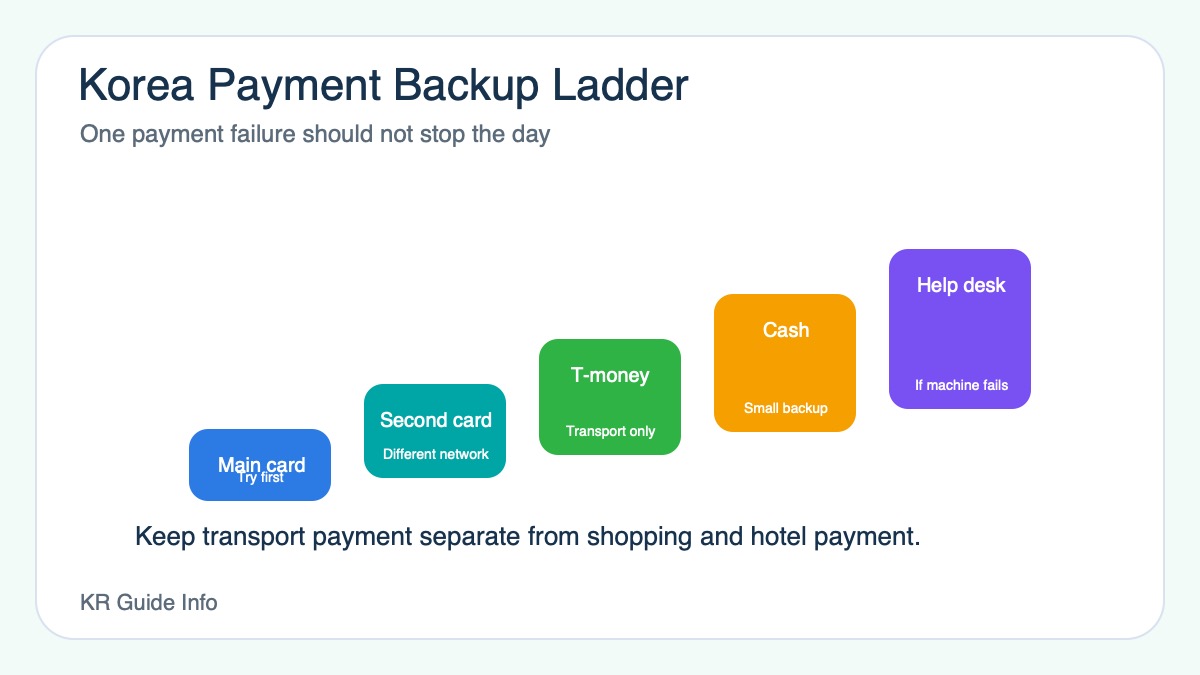
Foreign cards work in many places in Korea, but visitors should still keep a backup payment plan. Carry a second card, some cash for edge cases, and T-money for transport so one card decline does not disrupt meals, taxis, vending machines, or late-night movement.
Quick answer: Foreign cards work in many places in Korea, but visitors should not rely on one card only. Carry a backup card, a small cash reserve, and a transit payment plan.
Who this guide is for: Travelers who want to understand card acceptance, cash backup, and payment friction before arriving in Korea.
Card payments are common in Korea, but visitors should not mistake that for a guarantee that every payment moment will feel frictionless. A better plan is to assume cards will work often while still protecting yourself against the situations when they do not.
That is the practical middle ground most travelers need.
Why card confidence still needs a backup plan
Travel always works better when you avoid single points of failure. Even in card-friendly environments, a second card and a modest cash reserve can prevent small issues from interrupting the day.
The point is not distrust. It is resilience.
What helps foreign card use go more smoothly
- Bring more than one card
- Make sure international use is enabled before departure
- Keep a modest cash reserve
- Avoid relying on one payment app or one card network only
These basics matter more than complicated payment strategy.
When payment friction is more likely to happen
Problems are more likely when travelers arrive with only one card, no backup cash, and no tested setup. The stress usually comes from lack of redundancy rather than from the payment system itself.
That is why preparation matters so much here.
What to avoid on a first trip
The biggest mistake is treating cards as a total replacement for all other planning. A reliable trip usually combines card convenience with one or two simple fallback options.
That approach is stronger than either extreme.
The best payment rule for visitors
Use cards as your main method, but never as your only method. If you do that, Korea’s payment environment usually feels easy to manage.
Stability matters more than theoretical convenience.
Official sources
Related KR Guide Info guides
- How Much Cash Do You Need In Korea
- Korea Sim Card Esim T Money Card Payment Guide
- T Money Card Guide For Tourists In Korea
How KR Guide Info checked this guide
This guide was reviewed by the KR Guide Info editorial team for foreign card payments in Korea. We checked tourist payment scenarios, card-terminal failure patterns, transit/payment separation, and official card/payment information where available before updating the article, then focused the advice on practical decisions a first-time foreign visitor is likely to make on the ground.
Where foreign cards are most likely to cause friction
Korea is card-friendly, but “card-friendly” does not mean every foreign card works in every situation. The practical risk is not daily shopping; it is getting stuck when you have no second option.
- Transit: do not assume a foreign credit card replaces a T-money card for local transport.
- Small shops or older terminals: have a second card or cash backup ready.
- Online booking: some Korean services may reject overseas cards even if in-person payment works.
- Hotel deposits or late-night taxis: keep one backup payment method separate from your main wallet.
Two-card rule for Korea travel
For a smoother trip, carry two independent payment options: one primary international card and one backup card from a different network or bank if possible. This is more useful than carrying a large amount of cash, because most failures are temporary terminal, issuer, or online-verification issues.
| Payment situation | Recommended backup |
|---|---|
| Hotel or car-style deposit | Second credit card with enough available limit. |
| Small restaurant or market | Small cash buffer. |
| Transit day | T-money balance plus a separate card for non-transit purchases. |
| Online reservation | Try official global channels first, then ask accommodation or station staff if blocked. |
Related KR Guide Info guides
- T Money Card Guide For Tourists In Korea
- How Much Cash Do You Need In Korea
- Korea Sim Card Esim T Money Card Payment Guide
Update log
- June 10, 2026: Added review-focused trust sections, current official source links, related internal guides, and this update log for AdSense readiness.
Payment backup guides to read next
Foreign cards usually work better when you also understand cash, transport cards, and everyday small-purchase situations.
- How much cash do you need in Korea? — choose a realistic backup cash amount
- Korea convenience store guide for travelers — see common small-purchase situations visitors run into
- Korea SIM, eSIM, T-Money, and payment guide — connect payment with arrival-day setup
Build a payment stack, not a single-card plan
Foreign cards work widely in Korea, but a successful trip should not depend on one card, one phone wallet, or one bank’s fraud system. Use layers so a temporary decline does not interrupt transport, food, or hotel check-in.
| Payment layer | Use it for | Main failure risk | Backup action |
|---|---|---|---|
| Primary physical card | Hotels, larger restaurants, retail | Issuer block or terminal rejection | Carry a second card on a different network |
| Secondary card | Recovery when the primary card fails | Stored in the same lost wallet | Keep it separately from the primary card |
| Mobile wallet | Compatible contactless terminals | Acceptance varies and battery can fail | Do not leave the physical cards at the hotel |
| Cash reserve | Small merchants, reloads, emergencies | Carrying too much | Split a modest amount between secure locations |
| T-money | Local buses and subway | Insufficient balance | Know a nearby cash reload location |
Before departure
- Enable overseas use and confirm your bank’s app works outside your home country.
- Save issuer contact details separately from the card.
- Know whether your card charges foreign transaction or cash-advance fees.
- Do not accept dynamic currency conversion automatically; compare the KRW option and your issuer’s terms.
This guide evaluates payment resilience, not approval guarantees. The merchant terminal and card issuer make the final authorization decision.
FAQ
Can I travel Korea with only a foreign credit card?
Many travelers use foreign cards successfully, but relying on only one card is risky.
Do I need cash in Korea?
You may not need much cash, but carrying some is useful for edge cases and peace of mind.
Are mobile wallets enough for Korea travel?
They can help in some situations, but acceptance varies. A physical card and a transit plan are safer backups.