Last checked: June 10, 2026
Quick answer
A 3-day Seoul itinerary should be simple: one arrival-friendly day, one full sightseeing day, and one flexible day for shopping, food, or a focused neighborhood. Do not use a short trip to test every long-distance transfer in Korea.
Three days in Seoul is enough for a strong first visit if you keep the city grouped by district and stop trying to win every map battle. The real challenge is not finding enough things to do. The challenge is keeping the trip from collapsing into constant transfers.
Why Seoul works better when you group it by district
Seoul becomes easier once you stop treating every attraction like a separate mission. District-based planning reduces backtracking, protects your energy, and makes the city feel more coherent.
That matters even more on a short trip because long transfer chains can quietly consume a third of the day.
A practical three-day Seoul structure
- Day 1: central Seoul orientation, one classic area, easy evening district
- Day 2: one modern district plus slower food or shopping time
- Day 3: one flexible neighborhood day with a museum, river area, or cafe-heavy finish
This kind of structure gives you more of the city than a chaotic “top attractions” list because you actually have time to absorb where you are.
How to choose the right districts for your style
If this is your first trip, combine one classic Seoul area with one modern district and one flexible day. That mix gives you contrast without making every hour a logistics problem.
Your hotel base matters here. If you are still choosing where to stay, compare this plan with the Seoul accommodation guide.
What usually makes a short Seoul trip worse
The most common mistake is stacking too many neighborhoods into one day simply because they look close on a map. Seoul rewards depth more than frantic coverage. One district explored properly is often more memorable than three districts visited badly.
Another mistake is leaving no margin for weather, queues, transit exits, or the simple reality that city days take energy.
The best use of your final Seoul day
Keep the last day flexible. Use it for the district that best matched your pace, a river-focused afternoon, or a lighter museum and cafe day. Flexibility is what turns a short Seoul trip from “efficient” into genuinely enjoyable.
If you leave Seoul wanting more rather than feeling exhausted, the plan probably worked.
Why city logic matters more than attraction logic in Seoul
3-Day Seoul Itinerary for First-Time Visitors works best when you remember that Seoul is easier to enjoy when districts make sense together. Travelers often imagine Seoul as a set of attractions, but the city feels better when it is treated as a set of neighborhoods with different rhythms, transport burdens, and evening patterns.
How to make Seoul feel easier day after day
- Use one main district as the anchor for the day
- Choose accommodation that reduces repeated return friction
- Let neighborhood rhythm matter as much as attraction count
- Keep one flexible block in the itinerary for weather or energy changes
Protect the three-day itinerary from transfer overload
Three days in Seoul works when each day has one geographic center. Do not treat a short subway distance as proof that several distant districts belong in the same day.
| Day structure | Anchor | Flexible addition |
|---|---|---|
| Historic-center day | Palace/Jongno area | Insadong or a nearby evening district |
| Modern-neighborhood day | Choose one of Hongdae, Gangnam, or eastern Seoul | One nearby shopping or café area |
| Arrival/departure day | Hotel-side activity | Only if luggage and flight/train timing allow |
Keep the first evening recoverable and leave one optional block each day. Bad weather, fatigue, and a longer meal should remove the optional block—not force the fixed booking or last train into a rush. Choose the hotel area before finalizing the sequence because the same itinerary creates different transfer loads from Hongdae, Myeongdong, and Gangnam.
Official sources
- Visit Seoul official site
- Seoul Metropolitan Government English site
- Visit Korea official tourism site
Related KR Guide Info guides
Update log
- June 10, 2026: Added review-focused trust sections, current official source links, related internal guides, and this update log for AdSense readiness.
How KR Guide Info checked this guide
This guide was reviewed by the KR Guide Info editorial team for 3-day Seoul itinerary pacing. We checked neighborhood grouping, arrival-day friction, subway crossing time, and first-time visitor fatigue points, then added practical decision points for first-time foreign visitors rather than only listing places or features.
A realistic 3-day Seoul pacing rule
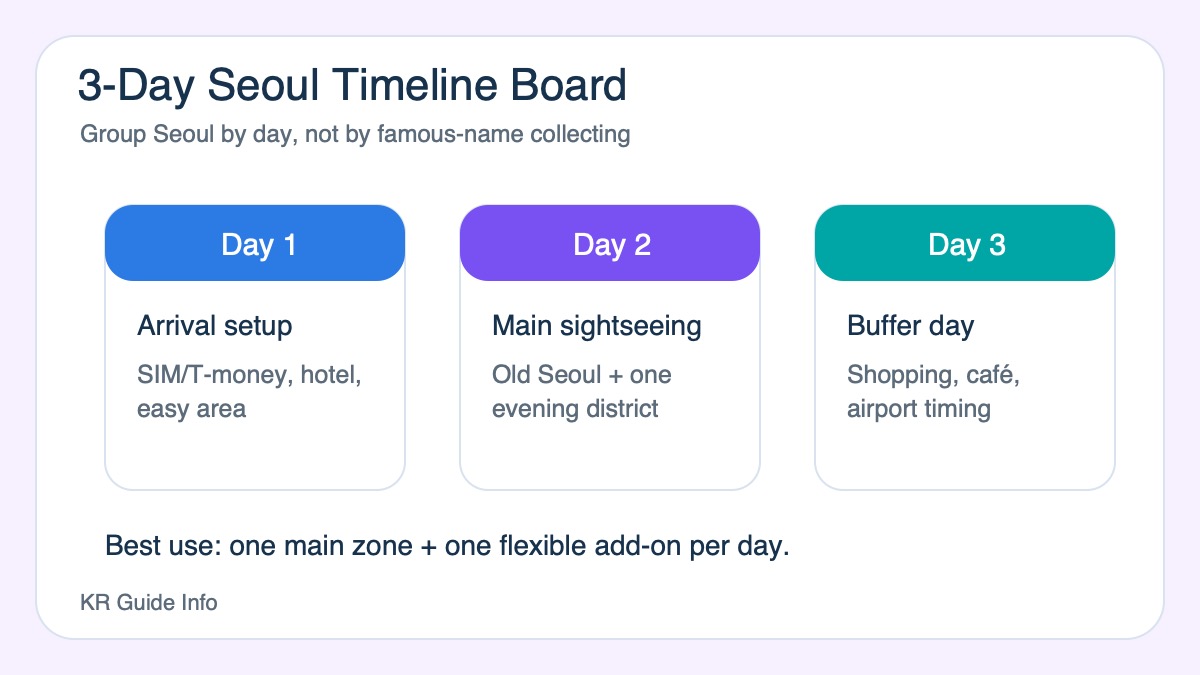
For a short Seoul trip, the main risk is not missing one attraction; it is crossing the city too often and losing energy before evening. Group each day around one main area and one flexible add-on.
| Day type | Better plan | Avoid |
|---|---|---|
| Arrival day | Hotel check-in, SIM/T-money setup, one easy neighborhood | Palace + market + river + shopping all after a flight |
| Main sightseeing day | Palace/old Seoul plus one nearby evening area | Jumping from north Seoul to Gangnam to Hongdae in one day |
| Final day | Shopping, café, airport transfer buffer | Booking a far attraction before luggage pickup |
Related KR Guide Info guides
If your Seoul trip is part of a longer Korea route
A short Seoul plan is easier when it fits a realistic full-trip structure and season.
- 7-day Korea itinerary for first-time visitors — expand a Seoul base into a balanced first Korea trip
- Best time to visit Korea by season — adjust indoor/outdoor pacing to the season
- Korea arrival checklist for first-time visitors — confirm the basics before the trip starts