Last checked: June 30, 2026
Disclosure: This guide is editorial and independent. It does not sell train, flight, or bus tickets. Always confirm live timetables, seat availability, terminal changes, and operating notices on the official operator pages before paying.
Quick answer
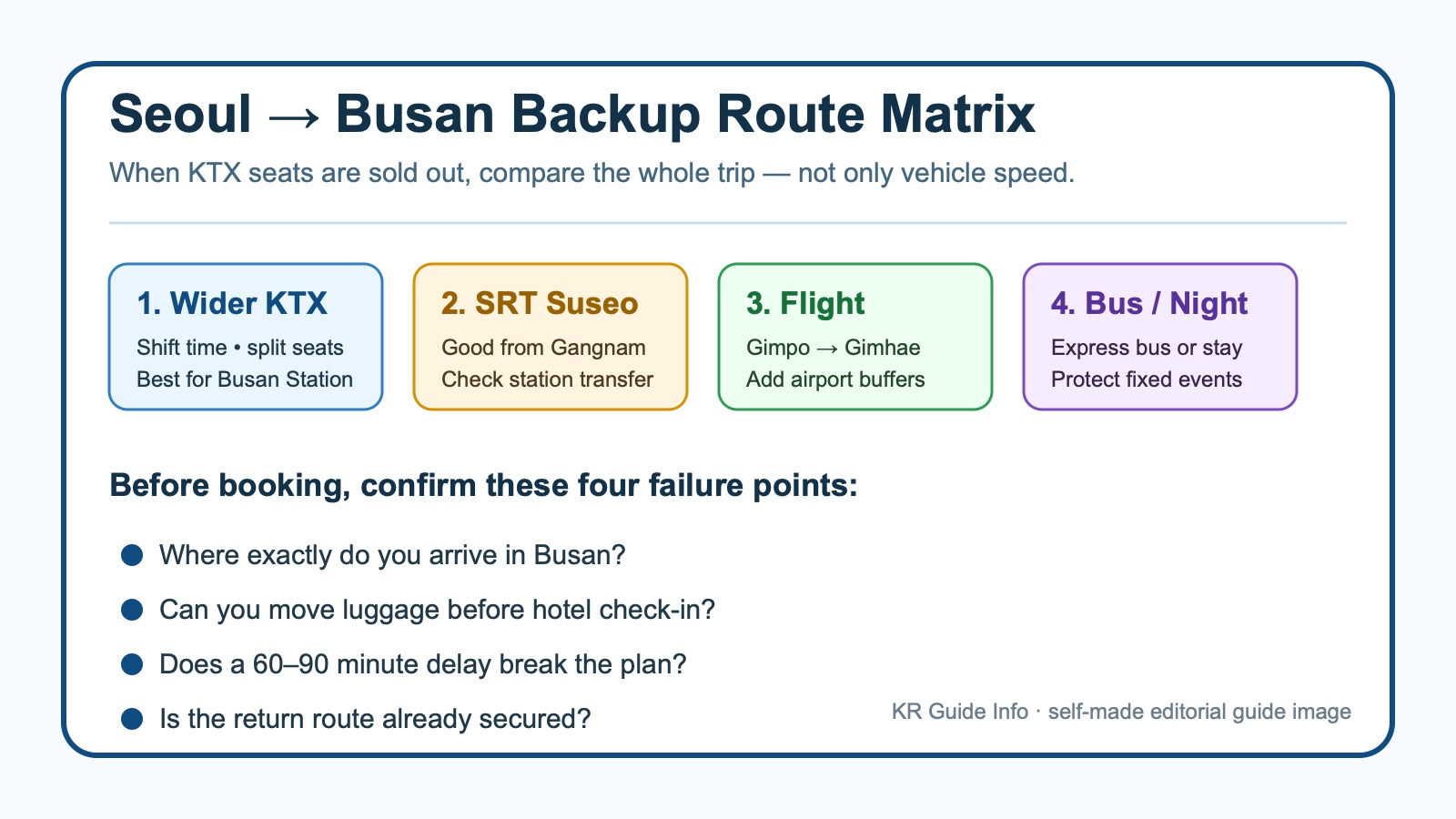
If the Seoul–Busan KTX seats you want are sold out, do not keep refreshing only one route. Work through four backups in this order: check nearby KTX departure windows and transfer patterns, compare SRT from Suseo, compare Gimpo–Gimhae flights with airport transfer time included, then use an express bus or split the trip with an overnight stay. For concert or event travel, the safest backup is usually the option that gets you to Busan the day before, not the option that looks fastest on paper.
Who this guide is for
This guide is for foreign visitors who planned to travel from Seoul to Busan but found that the obvious KTX seats are no longer available. It is especially useful during concert weekends, festivals, holidays, school breaks, or any period when many people are moving between the two cities at the same time.
The aim is not to predict live availability. Instead, it gives you a decision process you can use while checking the official booking pages. It also explains the hidden time costs that are easy to miss if you are new to Korea: station changes, airport transfers, luggage handling, late check-in, T-money needs, and what happens if you arrive in Busan after the subway becomes inconvenient.
Start with the problem: sold out does not always mean impossible
When travelers say “KTX is sold out,” they often mean one of these different problems:
- The exact Seoul Station to Busan Station train at the preferred time has no standard seats.
- Only awkward departure times remain, such as very early morning or late night.
- The direct train is unavailable, but a transfer route may still appear.
- Mobile booking failed because of payment, browser, or account issues.
- The group wants seats together, but individual seats are still appearing separately.
Before switching to a flight or bus, identify which problem you actually have. A single traveler with flexible timing may still have options. A group with luggage and a fixed hotel check-in window should move to backup planning faster.
Decision table: which backup should you check first?
| Situation | Best first backup | Why it works | Watch out for |
|---|---|---|---|
| You are near Seoul Station and can travel earlier/later | Different KTX time or transfer pattern | Least change to the original plan; Busan Station arrival is convenient | Do not rely on last-train timing for concert days |
| You are staying in Gangnam/Jamsil/COEX area | SRT from Suseo | Suseo may be easier than crossing Seoul to Seoul Station | SRT does not depart from Seoul Station; check how you will reach Suseo |
| You have a passport, light luggage, and a flexible airport transfer | Gimpo to Gimhae flight | Can be useful when rail seats disappear | Airport time can erase the flight-time advantage |
| You are price-sensitive or rail/flight options are poor | Express bus | More departures may exist across the day | Traffic, terminal location, and late arrival transport |
| Concert/event starts the next day | Overnight in Busan or a midway city | Reduces same-day failure risk | Hotel check-in and luggage storage strategy |
Step 1: Re-check KTX intelligently before abandoning rail
KTX is still the cleanest option for many first-time visitors because it usually puts you at Busan Station, close to subway Line 1, taxis, luggage services, and many hotel areas. But do not search only one perfect train.
- Search a wider time band. If you wanted late morning, check early morning and early afternoon too.
- Check nearby departure stations only if you understand the transfer. Seoul Station is the default for many travelers, but your actual lodging area may make another route practical. Do not add a difficult station transfer just to save a few minutes on the train.
- Consider splitting the group. If two people can travel separately and meet at Busan Station, availability may be easier than four seats together.
- Compare the return trip now. A one-way solution is not enough during event weekends. If you cannot get back to Seoul after the event, you may need an extra night.
Foreign-card note: payment success can vary by card issuer, browser, and security verification. If an official booking page fails at payment, try a different card or device before assuming all seats are gone. Avoid unofficial resale channels unless you fully understand the risk and cancellation rules.
Step 2: Check SRT from Suseo if your Seoul base makes sense
SRT is often overlooked by visitors because it does not use Seoul Station. It departs from Suseo Station in southeast Seoul, which can be convenient if you are staying around Gangnam, Jamsil, COEX/Samseong, or southern Seoul. If you are in Myeongdong, Hongdae, or near Seoul Station, the station transfer may be less attractive.
Use this simple rule: if reaching Suseo takes about the same effort as reaching Seoul Station, check SRT early. If reaching Suseo requires a stressful cross-city transfer with luggage, do not let a theoretical rail backup create a new problem.
| Where you sleep in Seoul | SRT from Suseo? | Reason |
|---|---|---|
| Gangnam, Jamsil, COEX/Samseong | Strong candidate | Suseo is on the southeast side of Seoul |
| Myeongdong, Seoul Station, City Hall | Compare carefully | KTX from Seoul Station may still be simpler |
| Hongdae, Sinchon, Mapo | Usually less convenient | Cross-city transfer adds time and luggage friction |
| Incheon Airport arrival day | Use caution | Airport-to-Suseo timing can be tiring after a flight |
Step 3: Compare a Gimpo–Gimhae flight without fooling yourself
A Seoul-to-Busan flight can look much faster than the train when you compare only time in the air. For real travelers, the useful comparison is door-to-door:
- Time from your Seoul hotel to Gimpo Airport
- Check-in, security, boarding, and delay buffer
- Flight time and baggage claim if checked luggage is involved
- Gimhae Airport to your Busan hotel or event area
- Late-night transport if the flight arrives after the easy subway window
Flights can still be the right answer when rail is fully booked, when you have light luggage, or when your Seoul accommodation is already convenient for Gimpo Airport. They are less attractive if you are carrying large suitcases, traveling with children, or trying to reach a concert venue the same day with no buffer.
Step 4: Use express buses as a real backup, not a last-minute panic choice
Express buses can be valuable when rail and flights are poor, but foreign visitors should plan the terminal and arrival side carefully. Seoul has multiple bus terminals, and Busan arrivals may not match your hotel area. Check the official reservation site and confirm the terminal name before you book.
For a same-day concert or timed event, a bus is usually safer as an early-morning or previous-day option than as a tight afternoon backup. Road traffic is the variable you cannot fully control.
Step 5: Decide whether an overnight backup is smarter
If the purpose of the trip is a major concert, festival, ferry, or morning tour, the best backup may be not a faster vehicle. It may be arriving in Busan the night before.
Use an overnight strategy when:
- The event has a fixed start time and missing it would ruin the trip.
- You have international luggage and cannot move quickly between stations.
- Return seats are also limited, making the whole weekend fragile.
- Your accommodation in Busan allows late check-in or luggage storage.
If hotels near the event area are expensive, consider transport-friendly areas such as Busan Station, Seomyeon, or other districts with easy subway/taxi access. Do not choose a cheaper hotel in an area you cannot reach comfortably after arrival.
Concert and event weekend planning: avoid the same-day trap
For large events in Busan, including major stadium concerts, the travel problem is not only getting into Busan. It is also getting from arrival point to hotel, from hotel to venue, and from venue back to a safe late-night area. A plan that arrives at Busan Station two hours before doors open may look acceptable until one delay, payment issue, luggage queue, or wrong subway exit breaks it.
A safer event-weekend version of the plan looks like this:
- Arrive in Busan the day before if budget allows.
- Sleep near a transport hub rather than chasing the cheapest distant room.
- Store luggage before going to the venue; do not take suitcases to a stadium area.
- Save offline copies of tickets, hotel address in Korean, and return route.
- Keep one taxi fallback budget for late-night movement.
Luggage strategy when your backup is not KTX
KTX to Busan Station is luggage-friendly compared with many backup routes because you stay within major rail infrastructure. Flights and buses can add extra handling points. Before booking a backup, ask:
- Can I lift my bag quickly on stairs or into a vehicle?
- Will my hotel store luggage before check-in?
- Do I need to go directly to an event before hotel check-in?
- Will I arrive after normal front-desk hours?
If the answer is uncertain, book the option that reduces transfers rather than the option that looks fastest.
Payment, apps, and documents to prepare
- Passport name: keep your booking name consistent with your travel documents where required.
- Foreign cards: prepare more than one card if possible; online payment failures can happen.
- Korean address: save your hotel address in Korean for taxis and map apps.
- T-money or transport card: useful after arrival in Busan, especially for subway/bus movement.
- Map apps: Naver Map or Kakao Map are often more reliable in Korea than relying only on global map apps.
- eSIM/SIM: do not depend on station Wi-Fi when changing plans under stress.
One-page backup checklist
| Before paying | Question to answer |
|---|---|
| Arrival point | Where exactly do I arrive in Busan: Busan Station, Gimhae Airport, or a bus terminal? |
| Next move | Can I reach my hotel or event area without a difficult transfer? |
| Luggage | Can I store bags before check-in or after check-out? |
| Return | Is my return route also secured? |
| Delay buffer | If I arrive 60–90 minutes late, does the trip still work? |
| Payment proof | Do I have confirmation, QR/ticket details, and refund/cancellation notes saved? |
Recommended backup order for most foreign visitors
- Flexible KTX search if you can shift time and still arrive comfortably.
- SRT from Suseo if your Seoul location makes Suseo practical.
- Flight from Gimpo to Gimhae if you have enough airport buffer and light luggage.
- Express bus if the schedule, terminal, and arrival transport are acceptable.
- Overnight adjustment if the event or next-day plan is too important to risk.
The “best” choice is not always the fastest. It is the one with the fewest failure points for your hotel location, luggage, payment method, event time, and return plan.
Official sources to verify before booking
- KORAIL official ticket booking
- SRT official site
- Korea Express Bus integrated reservation
- Korea Airports Corporation airport information
- Busan Metro official English site
- Visit Busan official travel information
Use official pages for live schedules, booking rules, cancellation rules, terminal names, and service notices. This guide intentionally avoids quoting specific fares or seat availability because they change by date, operator, route, and booking class.
Related KR Guide Info guides
- Busan Station Arrival Guide for Foreign Visitors
- Gimhae Airport to Busan Guide for First-Time Visitors
- Korea SIM Card, eSIM, T-Money Card and Payment Guide
FAQ
Is SRT the same as KTX?
No. Both are high-speed rail options, but they use different booking systems and Seoul-area departure points. The most important visitor difference is that SRT uses Suseo, not Seoul Station. That can be convenient from southeast Seoul and inconvenient from northwest or central tourist areas.
Is flying from Seoul to Busan faster than KTX?
Sometimes, but not always door-to-door. A flight can be useful when rail seats are unavailable, but you must include travel to Gimpo Airport, check-in/security time, baggage claim, and transport from Gimhae Airport into Busan.
Should I wait for cancelled train seats to appear?
You can keep checking, but do not make cancellation luck your only plan for a fixed event. Set a deadline: if no acceptable rail option appears by then, book the best backup that still protects your arrival time.
Are express buses okay for first-time visitors?
Yes, if you confirm the terminal names and allow traffic buffer. They become stressful when travelers assume every Seoul or Busan bus terminal is interchangeable. Save the terminal name in Korean and check the onward route before paying.
What is the safest plan for a Busan concert weekend?
Arrive the day before if possible, stay near a transport hub, store luggage before going to the venue, and secure the return route before the concert day. Same-day travel can work, but it has more failure points.
Update log
- June 30, 2026: Created as a practical Seoul-to-Busan backup planning guide after the initial Busan concert cluster, with official source links and no fixed fare or availability claims.