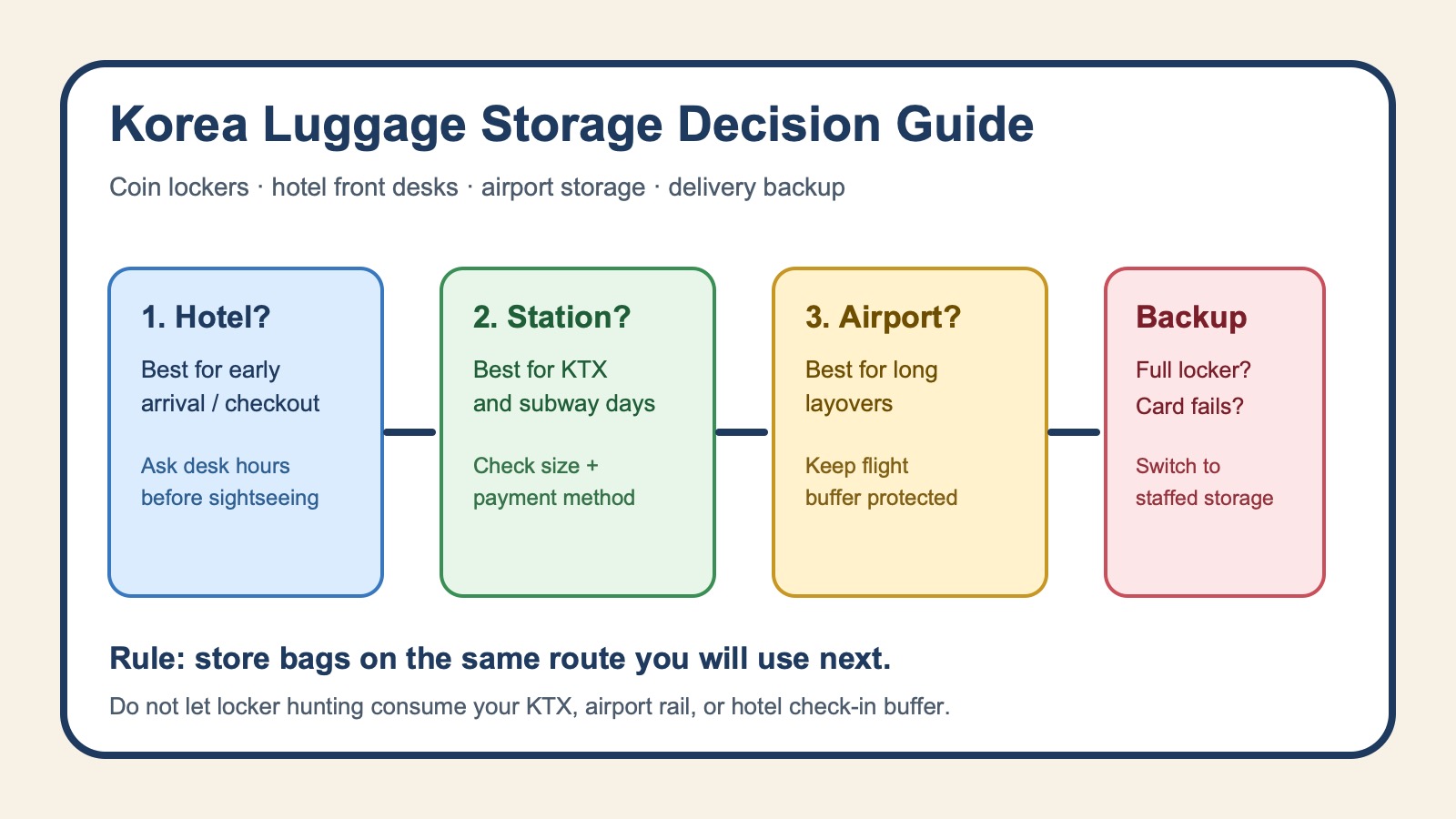
Last checked: July 7, 2026 · Disclosure: This guide is editorial only. It does not contain paid luggage-storage links. Always confirm same-day prices, operating hours, and oversized-bag rules with the station, airport, hotel, or storage operator you use.
If your Korea itinerary has an early arrival, a late check-in, a beach stop before the train, or a last day between hotel checkout and an evening flight, luggage storage becomes a real travel problem. Korea has many lockers, but the hard part for foreign visitors is knowing which backup to use when the first locker bank is full, your suitcase is too large, or the payment screen does not like your card.
.jpeg)
Quick answer: choose your luggage backup by the kind of day you have
| Your situation | Best first choice | Backup if it fails | Why |
|---|---|---|---|
| Arriving before hotel check-in | Ask your hotel front desk first | Nearby subway/KTX station locker | Hotel storage is usually easiest because you return there later anyway. |
| Changing cities by KTX | Station coin locker at your departure or arrival station | Paid storage/delivery counter if available | It avoids dragging luggage through cafes, attractions, and subway stairs. |
| Last day before an airport train/bus | Store near Seoul Station, Hongdae, Myeongdong, or your airport line stop | Airport storage/counter service | You want your bag on the same route as your final transfer. |
| Large suitcase or multiple bags | Hotel storage or staffed storage service | Split bags into two lockers only if you can track the locker numbers | Many lockers fit carry-ons better than large checked suitcases. |
| Foreign card fails at a locker | Try T-money/cash option if the machine supports it | Use a staffed counter, hotel desk, or different station | Some machines are less foreign-card-friendly than shops or transport gates. |
How coin lockers usually work in Korea
Most station lockers are self-service. You choose an empty locker on the screen, place the bag inside, pay, and receive a receipt, code, QR screen, or phone-number-based confirmation. Retrieval normally requires the same machine, the same code, or the same phone number/card process. Do not walk away until you have saved the locker number and retrieval method.
The most common mistake is assuming every station has a suitcase-sized locker. Busy hubs such as Seoul Station, Busan Station, major subway transfer stations, and airport-linked stops are more likely to have lockers, but large lockers can fill first on weekends, holidays, festival days, and rainy days. Smaller neighborhood stations may have fewer lockers or none in the direction you enter.
Station lockers vs hotel storage vs airport storage
| Option | Use it when | Watch out for |
|---|---|---|
| Hotel front desk | You are sleeping at that hotel before or after storage | Small guesthouses may have limited space or unmanned hours. |
| KTX/subway station locker | You will pass the same station again | Full lockers, size limits, payment-language confusion. |
| Airport storage/counter | You have many hours before a flight or need to leave the terminal | Terminal location and operating hours; do not cut flight timing too close. |
| Luggage delivery | You want bags moved between airport/hotel or city stops | Reservation cutoff, hotel acceptance, and exact pickup/drop-off times. |
| Cafe or attraction storage | Only if officially offered | Do not assume a cafe, museum, or shop will hold luggage informally. |
A safer luggage plan for the first day in Seoul
- Before arrival: check your hotel’s luggage policy and front-desk hours. If the hotel has unmanned check-in, ask exactly where bags can be left.
- At Incheon Airport: decide whether your first activity is worth carrying luggage for. If not, go directly to the hotel area or use an airport/storage option before sightseeing.
- On the AREX route: Seoul Station and Hongik University are useful because they connect to popular accommodation areas. However, large lockers can be competitive, so keep a second station or hotel option ready.
- If you arrive before check-in: store at the hotel first, then start sightseeing nearby. This is usually less stressful than storing at a random station and returning across the city later.
Locker payment and phone-number problems
Some machines ask for a phone number, a password, a QR code, or a card confirmation. If you do not have a Korean phone number, try entering your roaming/eSIM number only if the screen clearly accepts it; otherwise choose a password or receipt option if available. Take a photo of the screen after payment, but do not photograph another traveler’s code or payment information.
Foreign credit cards usually work better in Korea than many first-time visitors expect, but unattended machines are the place where problems still happen. Keep at least one backup: a transport card with stored value, some cash, a second international card, or a staffed counter option. If a payment fails twice, move to a different machine instead of repeatedly locking the same card.
Large-suitcase checklist before you commit to a locker
- Measure by reality, not by label: wheels and handles can make a “medium” suitcase too tall.
- Check whether the locker door closes easily before paying if the system allows you to test the space.
- Do not force the door; a stuck suitcase can cost more time than finding another location.
- If you split bags into two lockers, save both locker numbers in your phone notes.
- Keep passport, wallet, medication, battery pack, and flight/train tickets with you.
Best places to think about luggage storage by route
Incheon Airport to Seoul
If you will go straight to the hotel after the airport, hotel storage is usually the cleanest solution. If you want to sightsee before check-in, store near the hotel area rather than at the airport unless you plan to return to the airport soon. For official airport facilities and terminal orientation, start with the Incheon Airport official site and the AREX official site.
Seoul Station and KTX days
Seoul Station is useful for KTX, airport rail, subway transfers, and last-day plans, but it is also one of the places where locker demand can be high. If your KTX departure is fixed, arrive early enough to solve luggage storage before boarding pressure starts. Use the broader Seoul Station guide for first-time travelers with this luggage plan.
Busan Station and regional day trips
For Busan-based day trips, storing at Busan Station can work well when your route begins and ends there. If your hotel is in Seomyeon or Haeundae, compare the time cost of returning to Busan Station against leaving bags at the hotel. On beach or coastal days, avoid taking a roller suitcase onto crowded buses or stairs if a station/hotel option exists.
What to do if every locker is full
- Do not wait beside one locker bank too long. Search the station for another locker area or ask staff where the next bank is.
- Switch from station to hotel logic. If your hotel is within 20–30 minutes, storing there can be faster than hunting for lockers.
- Use a staffed storage/delivery service if available. It may cost more, but it removes payment-screen and size-limit issues.
- Change the itinerary order. Put luggage-friendly activities first: hotel area lunch, a mall, or a short indoor stop near the station.
- Protect your departure buffer. Never let locker hunting consume the time needed for KTX, airport rail, airport bus, or check-in.
Mini itinerary examples
| Day plan | Luggage strategy | Reason |
|---|---|---|
| 07:00 arrival at Incheon, 15:00 hotel check-in in Myeongdong | Go to hotel area, ask front desk to hold bags, then sightsee nearby | Reduces cross-city backtracking with luggage. |
| Seoul hotel checkout, 18:00 KTX to Busan | Store at hotel if returning nearby; otherwise use Seoul Station locker with early buffer | Keeps the bag near the final train route. |
| Busan day trip before evening hotel move | Leave bags at old/new hotel or Busan Station depending on route | Busan beach and hillside areas are not suitcase-friendly. |
| Late flight after daytime sightseeing | Store near airport rail/bus route, not far across town | Protects the final airport transfer. |
Official sources to check before you travel
- Incheon Airport for terminal layout, airport facilities, and departure timing.
- AREX for airport rail route information.
- Seoul Metro for subway network orientation and station information.
- KORAIL for national rail/KTX planning.
Related KR Guide Info guides
- Korea hotel check-in guide for first-time visitors
- Korea luggage delivery guide: airport to hotel
- Korea arrival checklist for first-time visitors
- Seoul Station guide for first-time travelers
Choose storage by retrieval risk
The best storage option is the one you can reliably retrieve before your next fixed connection. A convenient locker in the morning can become a problem if you must cross the city to collect the bag before a train or flight.
| Storage option | Best use | Failure point to check |
|---|---|---|
| Station locker | Short city stop with a return to the same station | Size availability, payment, station closing/access |
| Hotel storage | Before check-in or after checkout near your route | Guest-only rule and retrieval deadline |
| Staffed luggage service | Large bags or guaranteed storage preference | Opening hours and ID/receipt requirement |
| Delivery service | Avoiding a return trip to collect bags | Cutoff, destination coverage, delayed delivery |
Locker backup rule
Do not assume the first bank of lockers will have a large compartment. Save a second location in the same station complex or nearby, and do not put your passport, medicine, or next-connection ticket inside.
Editorial method: this guide separates storage by retrieval route and operational risk. Locker sizes, fees, and payment methods can vary by station, so the signs at the actual location remain authoritative.
FAQ
Are Korea coin lockers safe?
They are commonly used in major stations, but you should treat them as short-term convenience storage, not a place for irreplaceable valuables. Keep passport, cards, electronics, medication, and essential documents with you.
Can I store a large checked suitcase in a station locker?
Sometimes, but not always. Large lockers exist in many busy locations, yet they can fill quickly and may not fit every suitcase shape. Have a hotel, staffed storage, or delivery backup.
Do I need a Korean phone number to use lockers?
Not always, but some machines use phone-number or QR/password flows. If you are traveling without a Korean number, save every receipt/screen and avoid machines that do not clearly show a retrieval method you can use.
Should I store luggage at the airport or in the city?
Store at the airport only if your plan keeps you near the airport or you have a long airport-area layover. For city sightseeing before hotel check-in, city or hotel-area storage usually prevents backtracking.
Update log
- July 7, 2026: Built a first version focused on coin-locker decision rules, foreign-card/phone-number issues, and route-based backups for Seoul, airport, and KTX days.