Last checked: July 8, 2026. This guide is written for foreign visitors using taxis in Busan after arriving by KTX, domestic flight, ferry, or after a late event. It does not replace live route checks in Naver Map/Kakao Map or official transport notices.
Disclosure: This article is an independent travel guide. It is not affiliated with Busan taxi companies, Busan Metro, Busan City, or any app provider. Some related guides on this site may include affiliate links; this page focuses on practical transport planning.
Quick answer: when should a visitor use a taxi in Busan?
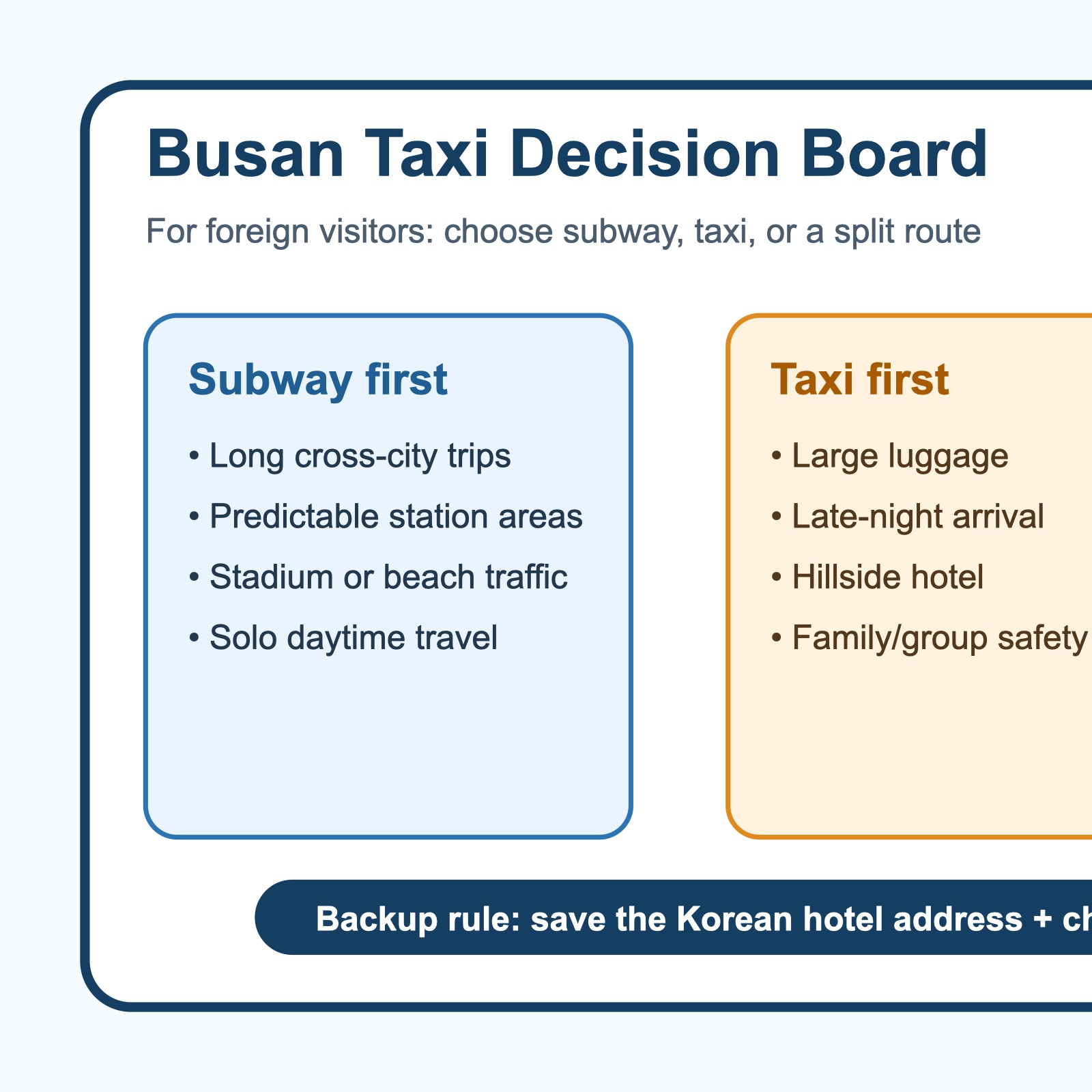
Use a taxi in Busan when the trip is short but awkward by subway, when you are carrying luggage, when you arrive late, when rain or heat makes transfers unpleasant, or when your group can stay together more safely by car. Do not treat taxis as the default for every move: Busan’s subway is usually easier for predictable cross-city trips such as Busan Station to Seomyeon, Seomyeon to Haeundae, or stadium-day travel when roads can be crowded.
The best strategy is a two-layer plan: use subway or airport/station rail for the main spine, then use a taxi for the final difficult segment. This is especially useful for hotels on hills, beach-area guesthouses, large suitcases, late-night arrivals, and multi-person groups who would otherwise split across buses or transfers.
Busan taxi decision table
| Traveler situation | Taxi is useful when… | Usually check first | Backup if it fails |
|---|---|---|---|
| KTX arrival at Busan Station | Your hotel is on a hill, in a narrow beach-area street, or you have large bags | Subway Line 1/transfer route and taxi stand queue | Store bags first, move by subway, then taxi from the nearest station |
| Gimhae Airport arrival | You arrive late, travel as a group, or your hotel is not close to the light rail/subway spine | Airport rail/subway transfer, arrival time, hotel check-in cutoff | Stay near Seomyeon/Busan Station, or message the hotel before leaving the airport |
| Haeundae or Gwangalli beach stay | You are moving at night, with luggage, or between beach areas | Subway last-train timing and walking distance from station | Walk to a main road before calling/flagging a taxi |
| Concert or stadium exit | You have mobility needs or a hotel far from the subway | Subway crowd control and meeting point outside the venue zone | Walk one or two blocks away from the crowd before requesting a ride |
| Rain, heat, or family travel | Transfers create more risk than the road delay | Weather radar, route walking segments, luggage size | Split the trip: subway for distance, taxi for the exposed final walk |
Step 1: decide whether the problem is distance, luggage, or timing
Foreign visitors often open a map app and simply compare total minutes. In Busan, that can be misleading because the hardest part is not always the long distance. A subway route may look slower but be more reliable; a taxi route may look faster but become uncertain near beaches, festivals, stadium exits, or rainy evenings. Before choosing, name the real problem:
- Distance problem: You need to cross the city, for example Busan Station to Haeundae. Subway is often the better base plan.
- Luggage problem: You have suitcases, stairs, or an awkward hotel street. Taxi may be worth it even for a short section.
- Timing problem: You are near last train, hotel check-in cutoff, airport departure, or a booked activity. Taxi is a backup, not a guarantee.
- Group problem: Your group includes children, older travelers, or people without separate eSIM access. A taxi can prevent the group from splitting.
If more than one problem applies, use the safest route rather than the cheapest-looking one. For example, after a late KTX arrival, a family staying in a hillside guesthouse may be better taking the subway to the nearest easy station and then a short taxi, instead of dragging bags up a dark slope.
Step 2: use apps, but keep a no-app taxi backup
Many visitors plan around Kakao T, but app setup can be uneven for foreign travelers depending on phone number, account verification, language comfort, and payment method. Do not make your first Busan taxi ride dependent on one app working perfectly at midnight. Prepare three methods:
- App request: Useful when you are away from a taxi stand or need to show a precise destination.
- Taxi stand: Most useful at airports, major stations, terminals, hotels, and large shopping or beach areas.
- Main-road hail: Useful when app matching is slow, but safer and easier on wide, well-lit roads than on small alleys.
Save your hotel name and address in Korean before you need it. A screenshot is not enough if your phone battery dies; keep the address in your notes app and in your booking confirmation. If your destination is a small guesthouse, use a nearby landmark, subway station exit, or major hotel as a meeting point, then walk the final short distance.
Step 3: plan payment before you get in
Card acceptance is common, but visitors should still carry a backup payment plan. Foreign cards can fail for reasons that are not obvious to the driver: issuer security settings, network problems, card type, or terminal issues. T-money is primarily a transit card, not a universal taxi solution for every visitor scenario, so do not rely on it as your only backup.
- Carry at least one physical payment card, not only a mobile wallet.
- Keep a small cash reserve for transport emergencies.
- Tell your bank you will travel in Korea if your card commonly blocks foreign transactions.
- If using an app payment method, still bring a physical backup card for the ride.
For broader card and transport preparation, pair this guide with the site’s Busan subway and T-money guide and Korea luggage storage guide.
Busan route examples: subway first, taxi second
| Route | Practical taxi strategy | Why it works |
|---|---|---|
| Busan Station to Haeundae hotel | Use subway for the long cross-city segment, then taxi from Haeundae/Jung-dong area if the hotel walk is hard | Avoids long road uncertainty while solving the final luggage problem |
| Gimhae Airport to Seomyeon | Compare taxi queue with airport light rail/subway transfer before deciding | Late arrivals and group luggage may justify taxi; solo daytime travelers may prefer rail |
| Gwangalli after dinner to Busan Station hotel | Check last train first; if near cutoff, move to a main road and request taxi before the crowd leaves | Reduces app matching stress and avoids wandering with luggage or tired travelers |
| Stadium or event area to Haeundae | Walk away from the venue surge, choose a landmark pickup point, then taxi or subway depending on crowd | Drivers and passengers need a clear meeting point after events |
Late-night taxi checklist
- Check the last subway timing before dinner or the event, not after.
- Save your hotel name, address, and nearest major landmark in Korean.
- Charge your phone before leaving the venue or beach area.
- Choose a pickup point on a wide road, not inside a packed alley or stadium gate.
- Keep your group together until the taxi is confirmed.
- Have a physical payment card and small cash backup.
- If no taxi matches, walk toward a station, hotel, convenience-store cluster, or main road rather than waiting in the same crowded spot.
If your arrival is after normal transport hours, also read the late-arrival Busan guide. If you are coming from the airport, compare this taxi approach with the Gimhae Airport to Busan guide. If you arrive by KTX, the Busan Station arrival guide helps you choose between subway, taxi, luggage storage, and first stops.
What not to do
- Do not wait at the most crowded gate after a concert or festival. Move to a clearer landmark where a driver can actually stop.
- Do not assume every driver will understand an English hotel name. Use the Korean address or a map pin.
- Do not depend on one phone. If your group separates, each subgroup needs the hotel address and a messaging plan.
- Do not put all luggage in a taxi before confirming the destination. Check the map/address first, then load bags.
- Do not ignore the subway just because you are tired. For long cross-city trips during busy periods, subway plus a short taxi can be calmer than one long taxi.
Official sources and live checks
Use official pages for current public transport and city information, then confirm your exact route in a Korean map app on the day:
- Visit Busan for official tourism information and area planning.
- Busan Metro / Humetro English site for subway network information.
- Busan Metropolitan City English site for city notices and public information.
- Gimhae International Airport English site for airport access and operating information.
FAQ
Is it better to take a taxi or subway from Busan Station?
For a hotel near a subway station, subway is often the easier first choice. Use a taxi when your hotel is uphill, far from the station exit, you have large luggage, or you arrive late enough that transfers feel risky.
Can I rely on taxi apps in Busan as a foreign visitor?
Use taxi apps if they work for your phone and payment setup, but prepare a taxi-stand or main-road backup. App setup, payment registration, and driver matching can be less predictable for visitors than for residents.
Are taxis a good idea after a concert in Busan?
They can be useful for mobility needs, late-night hotels, or groups, but the pickup point matters. Move away from the densest exit crowd and choose a clear landmark on a road where stopping is realistic.
What should I show the driver if I do not speak Korean?
Show the destination in Korean, preferably with a map pin and full address. For small guesthouses, show a nearby major landmark or station exit as a secondary option.
Update log
- July 8, 2026: First draft prepared with official Busan tourism, Busan Metro, Busan City, and Gimhae Airport source links checked. Live taxi fares, app policies, and road conditions were intentionally not quoted because they can change and should be checked in-app or with official notices near travel day.