Last checked: 2026-07-20. Disclosure: This guide is independent and not affiliated with Korail, bus operators, airports, hotels, or luggage services. It uses official links where possible and focuses on practical backup decisions for foreign visitors.
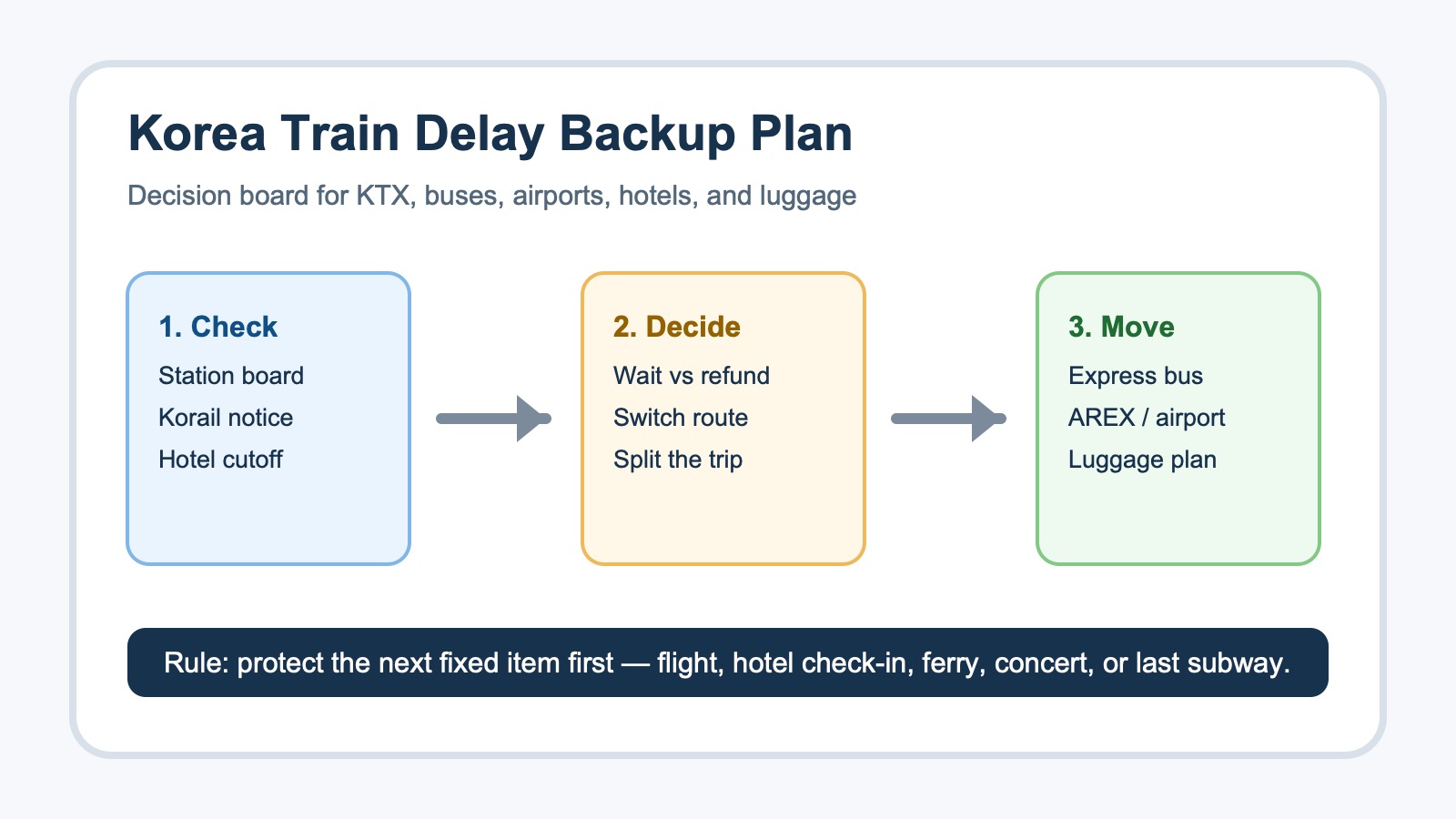
A delayed or cancelled train in Korea is stressful because many visitor plans are chained together: airport arrivals, KTX reservations, hotel check-in windows, luggage pickup, ferries, concerts, and last subway times. The safest response is not simply wait at the station. First protect the next fixed item in your day, then choose the smallest route change that keeps that item safe.
Quick answer: what to do first
- If you have a flight, ferry, concert, or same-night hotel deadline: start checking express bus and airport options immediately instead of waiting for one train update.
- If your delay is under about 30–40 minutes and your next step is flexible: stay near the platform, keep your ticket available, and watch official station displays.
- If the next train is sold out: compare three backups: a later train on the same line, a nearby station, or an express/intercity bus terminal.
- If luggage is the problem: solve luggage before the route. Lockers, hotel storage, or delivery cutoff times can decide whether a backup route is realistic.
Decision table: wait, change trains, or switch to bus?
| Situation | Best first move | Why it works | Watch out for |
|---|---|---|---|
| Short delay, no fixed deadline | Wait at the station and monitor displays | Changing plans can cost more time than the delay | Do not leave the paid area if announcements are unclear |
| KTX/SRT sold out after a cancellation | Check later trains plus nearby departure stations | Seoul, Yongsan, Suseo and other stations may serve different lines | Taxi/subway transfer time can erase the advantage |
| Need to reach another city today | Compare express bus and intercity bus terminals | Buses often have more same-day frequency on major city pairs | Terminal names may differ from train station names |
| Airport connection is at risk | Protect airport arrival time | Missing a flight is usually more expensive than losing a train fare | Leave buffer for baggage, security, and terminal transfer |
| Large luggage or child/elderly traveler | Choose the route with fewer transfers | Backup routes with stairs, crowded subway transfers, or long walks can fail | Paying more for a direct bus/taxi segment may be safer |
Step 1: confirm whether the problem is your train or the whole corridor
At the station, look for three signals: your train number, the destination, and whether many trains on the same line are delayed. If only your train is affected, a later train or different departure station may work. If the whole corridor is disrupted by weather, power issues, strike action, or a major incident, a bus or airport route may become the better backup.
For Seoul-area rail planning, read our Seoul Station guide for first-time travelers together with this article, because station layout and transfer time matter when you are making a fast backup decision.
Step 2: protect the next fixed item
Write down the latest safe arrival time, not the scheduled arrival time. For a domestic airport, that may mean arriving well before check-in closes. For an international flight, the buffer should be larger. For a hotel, confirm whether late check-in is possible. For a concert, ferry, tour, or restaurant booking, decide whether arriving late still has value.
- Flight: choose the most reliable airport arrival, even if it means abandoning the train plan.
- Hotel: message the hotel early if you may arrive after the desk closes.
- Luggage delivery: check pickup/drop-off cutoffs before rerouting.
- Last subway: if your new arrival is near midnight, plan the final taxi segment before boarding the backup.
Step 3: compare train backups realistically
Korea has several major rail patterns that can confuse visitors. Seoul Station is not the same as Suseo Station. Yongsan may be better for some southwest routes. A later train that looks only 40 minutes later may still fail if it reaches a different part of the city or misses your hotel/luggage deadline.
| Backup rail idea | Useful when | Practical check |
|---|---|---|
| Later train from same station | Delay is local or your deadline is flexible | Can you stay near the platform and keep food/water nearby? |
| Different Seoul-area station | Another line has seats or fewer delays | Add subway/taxi time plus ticketing time |
| Regular train instead of high-speed train | You value certainty over speed | Confirm arrival station and last local transport |
| Split journey | One direct train is sold out | Only do this if transfer time is generous and luggage is manageable |
Step 4: when to switch to express or intercity bus
Bus terminals can save a disrupted travel day, especially between major cities such as Seoul, Busan, Daegu, Daejeon, Gwangju, Jeonju, Gangneung, and regional hubs. However, foreign visitors should check the terminal name carefully. Central City, Express Bus Terminal, Dong Seoul, Nopo, and city intercity terminals may not be near the train station you planned to use.
If you are new to Korean transport cards, local transfers, or late-night buses, also review our public transport in Korea guide before relying on a tight backup route.
Airport-specific backup matrix
| Your train problem | Backup priority | Likely option | Extra note |
|---|---|---|---|
| Going to Incheon Airport from Seoul | Airport arrival time | AREX, airport limousine, taxi if late | Traffic matters for road options; rail is often more predictable |
| Arriving at Seoul Station too late for KTX | Reach destination city today | Later KTX/SRT, express bus, overnight stay | Do not ignore hotel check-in cutoff in the destination city |
| Regional train to airport area cancelled | Reduce transfers | Direct airport bus if available | Check whether the bus reaches your exact terminal |
| Large luggage plus missed train | Minimize walking | Direct bus/taxi segment, hotel storage | See luggage section before buying a non-refundable backup |
Luggage checklist before changing your route
- Can you carry your luggage through subway stairs, station corridors, and bus terminal walks?
- Does your hotel allow late luggage pickup or late check-in?
- Are station lockers large enough and still available?
- Will a luggage delivery service still accept same-day pickup or delivery?
- Would one short taxi ride make the backup route much safer?
For luggage-specific decisions, use our Korea luggage delivery guide as a companion article.
Refund and rebooking: practical visitor notes
Refund and change rules depend on the ticket channel, fare type, timing, operator, and the cause of the disruption. Keep screenshots of the train number, ticket, delay notice, and any station information if you need to explain the situation later to a hotel, tour company, travel insurer, or ticket office. If you bought through a third-party platform, check whether changes must be handled there rather than directly through the operator.
Official sources to check
Foreign-visitor fallback script at the station
- Take a screenshot of your ticket and the station delay board.
- Ask staff or information desk: Is this train delayed only, or are many trains cancelled?
- Check the next fixed item: flight, hotel, ferry, concert, tour, or luggage pickup.
- Search one rail backup and one bus backup before cancelling anything.
- If arriving late at night, plan the final subway/taxi segment before boarding.
- Message your hotel or tour provider early with a realistic arrival estimate.
FAQ
Should I cancel my KTX ticket as soon as I see a delay?
No. First confirm whether the delay is short, whether later trains have seats, and whether your next fixed item is at risk. Cancelling too early can remove your best option.
Is an express bus usually better than a delayed train?
Not always. Buses can be excellent backups, but terminal transfer time, road traffic, luggage, and final arrival location matter. Compare door-to-door time, not only timetable time.
What if I cannot understand station announcements?
Use the train number and destination on the display board, then ask staff with your ticket screen open. Translation apps help, but station staff can usually identify whether your specific train is delayed or cancelled.
Can I rely on taxis for the whole backup route?
For long intercity routes, a taxi can be very expensive and may not be practical. Taxis are usually best as a short connector to protect the airport, hotel, or bus/train terminal segment.
Update log
- 2026-07-20: First drafted with a visitor-focused train delay/cancellation decision table, bus and airport backup matrix, luggage checklist, official source links, and internal transport links.