Last checked: June 10, 2026
Quick answer
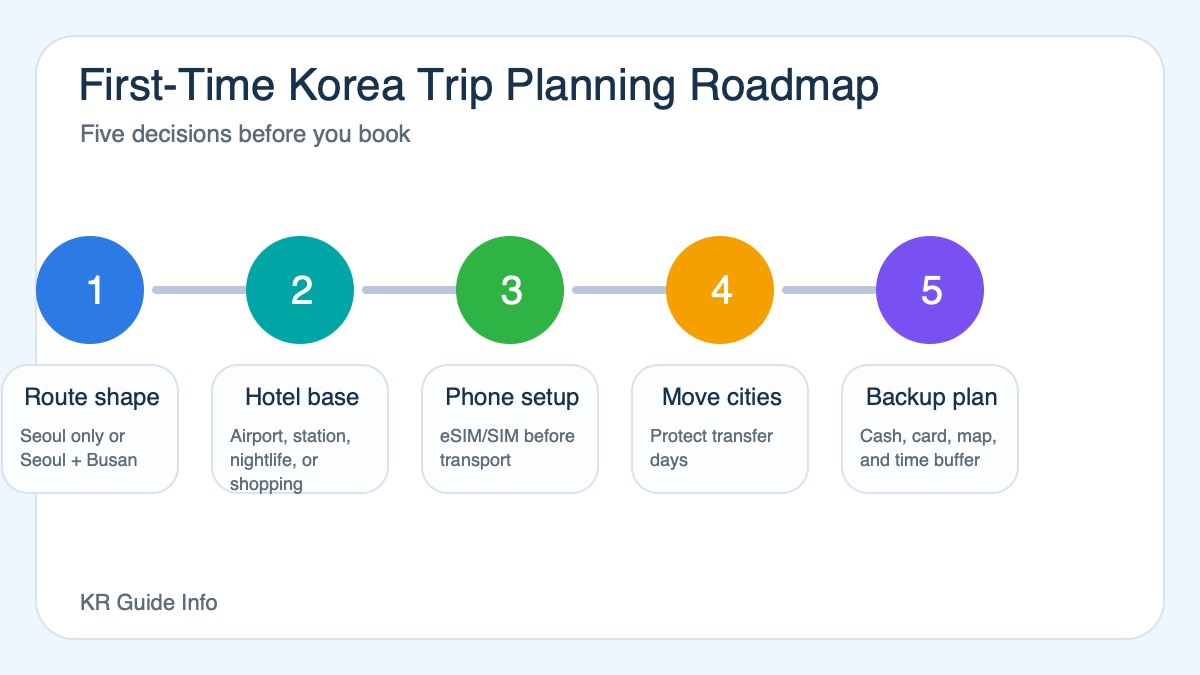
First-time Korea planning is easiest when you decide your route, season, transport setup, phone data, and payment backup before booking every hotel. Start with Seoul, add Busan or Jeju only when your days allow it, and keep arrival-day plans light.
Start with trip shape before you start collecting places
Before you compare districts, hotels, or attractions, decide what kind of first trip you want. Is this a Seoul-first city trip? A Seoul plus Busan split? A slower week with one day trip? A shorter orientation trip that is mainly about learning how Korea works?
That choice matters because it controls every other practical decision. If the trip is Seoul-only, you can stay more stable and spend less time rebuilding each day. If the trip includes a second city, you need to plan around one good transfer instead of squeezing too many cities into one week.
Most first-time visitors benefit from one primary base and only one major second-city move if time allows. A shorter trip usually feels better when you move less and understand more, rather than trying to prove that you visited everything on the map.
Choose accommodation by logistics, not by internet hype
The most useful accommodation question is not, “Which neighborhood is the coolest?” It is, “How much friction will this location create every morning and every night?” That is the question that shapes the whole week.
If you plan to spend most of your time in Seoul, prioritize an area with clear subway access, a comfortable airport transfer, and enough food and convenience options nearby. A slightly less fashionable location with smoother logistics often beats a trendier area that turns every evening return into work.
This is especially important on a first trip, because the city already asks you to think about maps, exits, pace, weather, and payment habits. A stable hotel base reduces that cognitive load. If you are still choosing where to stay, compare this with the Seoul accommodation guide.
Build a daily pace that matches real travel energy
Korea rewards travelers who keep a disciplined pace. Cities are dense, neighborhoods are walkable, and transit is strong, but that does not mean every day should be packed from breakfast to midnight. Transfers, station exits, stairs, weather, and meal timing still cost energy.
A good rule for first-time visitors is to build each day around one main district and only one or two secondary stops. That leaves enough room for simple things: coffee breaks, weather changes, a slower meal, or deciding you want more time somewhere than expected. Those are not planning failures. They are part of how a real trip works.
- Keep one main district as the anchor for the day
- Add only one or two secondary stops if they fit the route naturally
- Leave margin for transport, meals, and energy drops
- Do not assume map distance equals lived travel time
If the trip is starting to feel overbuilt, the problem is usually not “too few days.” It is that the route has too many competing centers of gravity.
Handle the basic setup early so day one feels easy
Before your first full sightseeing day, decide how you will handle mobile data, local payments, and transport basics. That means having a clear SIM or eSIM plan, understanding how your cards will work abroad, and knowing what local transport rhythm you want to rely on.
Those choices do not need to be perfect. They need to be stable. Most travelers benefit more from one clean, reliable setup than from comparing every possible option forever.
For that part of the trip, start with the Korea SIM, eSIM, T-money, and payment guide and the Korea public transport guide. Those two topics usually solve most first-day uncertainty.
Do not overbook your first visit
The most common planning mistake is building an itinerary that looks efficient on a map but feels exhausting in real life. It is better to do slightly less and understand where you are than to spend the whole trip transferring between places you barely experience.
If you are unsure where to start, make your first trip a practical orientation trip. Learn how Seoul moves, decide what pace suits you, and leave room for a future visit. That is not “missing out.” It is usually the decision that makes the first Korea trip feel most satisfying.
A strong first trip is not the one with the most pins saved. It is the one where your route, hotel, pace, and daily movement support each other well enough that the country actually feels accessible.
How this advice fits into your overall Korea planning
First-Time Korea Trip Planning Guide: What To Decide Before You Book works best when you use it to make one or two major decisions early instead of collecting endless possibilities. Planning guidance is most valuable when it simplifies the route, the hotel base, or the first-day setup. Once one of those things becomes clearer, many other decisions become easier automatically.
What a realistic first-time traveler should optimize for
- Prioritize one strong hotel base over several weak hotel moves
- Leave room for meals, weather changes, and energy drops
- Use planning to remove uncertainty, not to create a rigid schedule
- Decide the trip structure before collecting too many attractions
How KR Guide Info checked this guide
This guide was reviewed as a practical first-trip planning decisions guide for foreign visitors, with the goal of reducing real travel friction rather than adding generic destination description.
- compared the guide against common first-arrival tasks: route length, base choice, transport setup, payment backup, and seasonal fit
- kept advice focused on decisions that change bookings or arrival-day stress, not sightseeing filler
- cross-checked official links for entry, transport, and tourism planning points before leaving the guide live
Official sources
Related KR Guide Info guides
- Korea Arrival Checklist First Time Visitors
- How To Use Public Transport In Korea
- Korea Sim Card Esim T Money Card Payment Guide