Last checked: 5 June 2026. Airport access, public transport routes, and operating details can change during major events, weather disruption, or temporary traffic control. Use this guide as a planning framework, then confirm your actual day-of route with Gimhae International Airport, Busan Metro, your airline, and a navigation app before you travel.
Disclosure: This independent guide is not affiliated with any government office, transport operator, venue, ticketing company, hotel, airline, or event organizer. It is written for practical travel planning, and any official schedules, rules, or prices should be checked with the relevant official source before you travel.
Editorial note: This guide is written for foreign visitors arriving at Gimhae International Airport and trying to reach Busan without confusion. It is not affiliated with Gimhae Airport, Busan Metro, any airline, or any concert organizer.
Quick answer
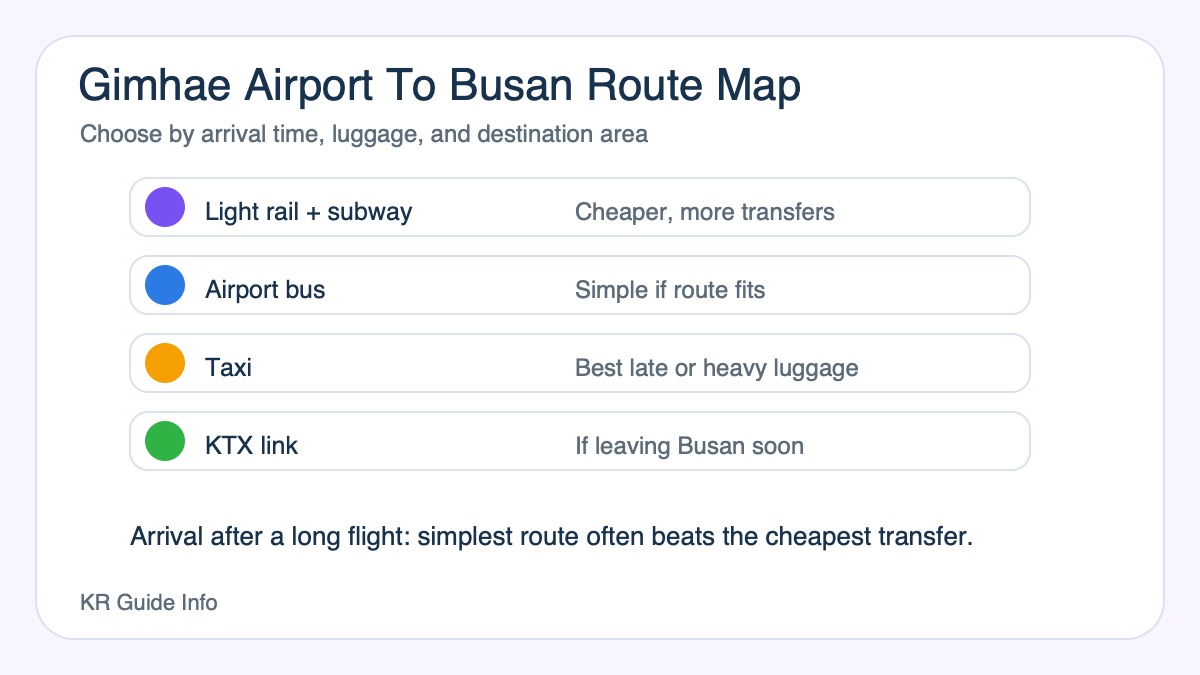
For most first-time visitors, the easiest route from Gimhae Airport to central Busan is: Gimhae Airport → Busan-Gimhae Light Rail Transit → Sasang Station → Busan Metro. Choose this if you have manageable luggage, mobile data, and your hotel is near a subway station. Choose a taxi if you are arriving late, carrying large concert luggage, traveling with a group, or staying somewhere that requires awkward transfers.

| Destination in Busan | Most practical first choice | Why it works | When to switch plans |
|---|---|---|---|
| Seomyeon | Light rail to Sasang, then metro | Central base, good for first-timers and transfers | Late arrival, heavy bags, or rain |
| Busan Station | Light rail + metro via Sasang | Best if you connect to KTX or stay near the station | If you are exhausted after a long-haul flight |
| Haeundae / Gwangalli | Metro if time is not tight; taxi if bags are heavy | Good for beach stays, but farther from the airport | Late-night arrival or hotel far from the metro |
| Sajik / Busan Asiad Main Stadium area | Metro/taxi combination | Useful for major stadium events | Event-day congestion or unclear last-mile route |
Before you land: decide your route by luggage, time, and hotel area
Many airport guides start with “take the train” or “take a taxi.” That is too simple for Busan. Gimhae Airport is close to the city, but Busan is long and spread out. A route that feels easy to Seomyeon may feel tiring to Haeundae after immigration, baggage claim, summer humidity, or a delayed flight.
Use this decision order:
- Check your hotel area first. Save the hotel name and address in English and Korean. If your hotel is near Seomyeon, Busan Station, or a major metro stop, public transport is usually manageable. If it is on a hill, near a beach side street, or outside the metro grid, budget for a taxi for the final leg.
- Count your bags honestly. One suitcase plus a backpack is manageable on the airport rail and metro. Two large suitcases, concert merchandise, camera gear, or a stroller can make transfers stressful.
- Check arrival time. Do not plan a tight evening schedule immediately after landing. Flight delays, immigration queues, SIM/eSIM setup, ticket pickup, and navigation confusion can all add time.
- Prepare a data backup. Install Naver Map or KakaoMap before arrival. Google Maps is useful for orientation in Korea, but local apps are usually better for public transport details.
Option 1: Light rail plus Busan Metro
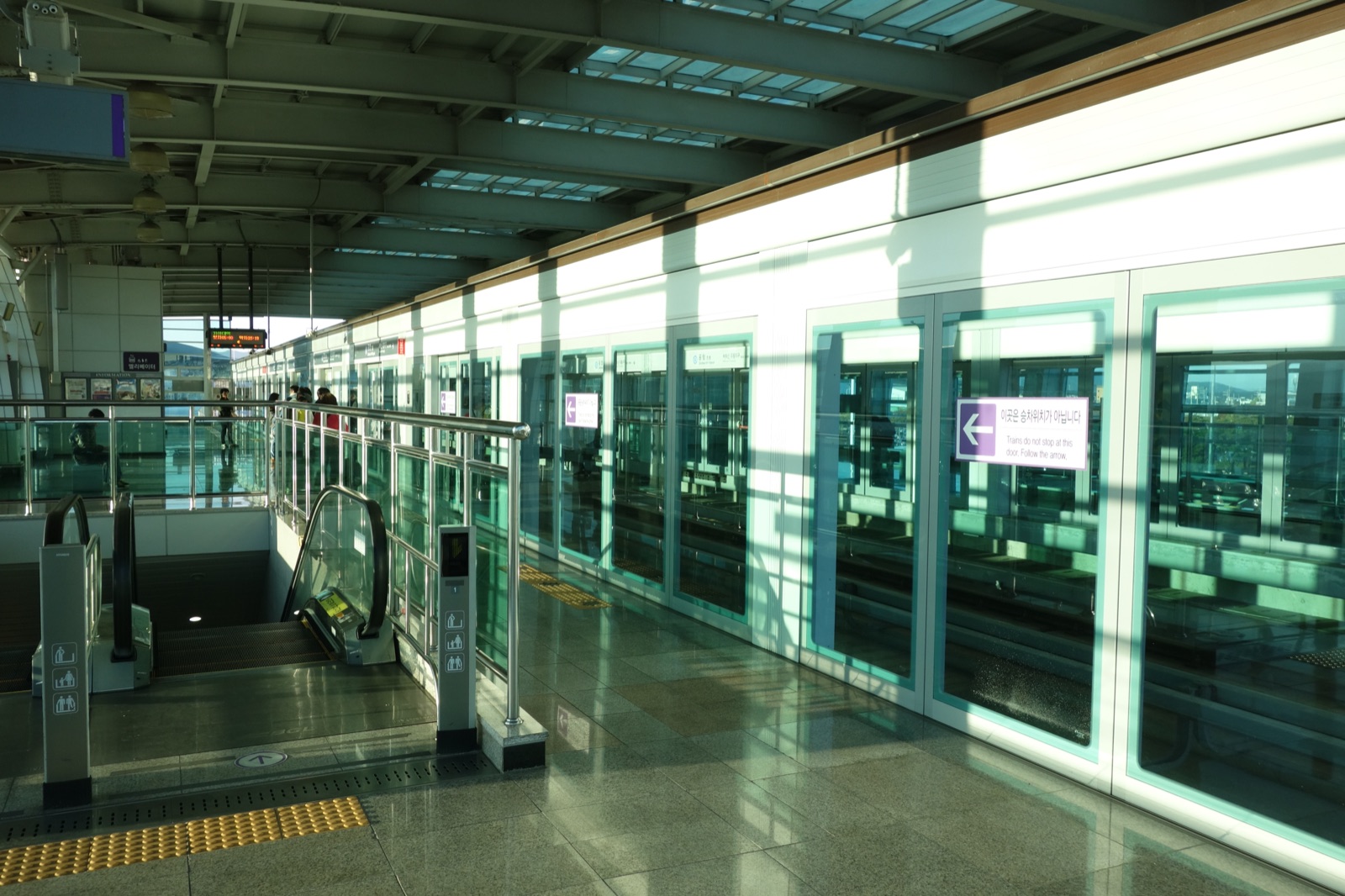
The public-transport route starts with the Busan-Gimhae Light Rail Transit from the airport. Many visitors use it to connect at Sasang Station, where they can transfer to the Busan Metro network. This is often the best balance of cost, predictability, and avoiding road traffic.
Use this route if:
- your hotel is within walking distance of a metro station;
- you arrive during normal daytime or evening hours;
- you can carry your own luggage up/down station paths if elevators are crowded;
- you already have a T-money card or can buy/top up one after arrival;
- you are comfortable following transfer signs in a busy station.
Do not rely on memory for platform numbers or last-train timing. Check the day-of route inside Naver Map, KakaoMap, or the official Busan Metro/Humetro information before leaving the arrival hall.
Option 2: Taxi from Gimhae Airport
A taxi is the simplest physical route: airport curb to hotel. It can be worth it if you are arriving with heavy luggage, staying in Haeundae or Gwangalli, traveling as two or more people, or landing late after a long flight. It is also a reasonable backup on rainy days, when you are tired, or when you need to reach a hotel before check-in closes.
Before getting in, prepare:
- your hotel name in Korean;
- the full road address;
- a phone number for the accommodation;
- a screenshot of the map pin;
- a backup payment method in case a foreign card is not accepted smoothly.
Avoid inventing a “normal fare” in your plan. Taxi cost depends on distance, time, traffic, tolls, surcharges, and the exact hotel location. If price matters, compare the live taxi estimate inside a Korea navigation or taxi app when you land.
Option 3: Airport bus or city bus
Buses can be useful for some districts, but they are less beginner-proof than the light rail and metro. Route numbers, stops, temporary detours, and luggage comfort can change. If you are a first-time visitor, use buses only when an official airport page or local navigation app shows a clear route to your exact hotel area.
Buses are most useful when:
- your hotel is near a direct stop;
- you are not traveling with oversized luggage;
- you can recognize your stop name in English/Korean;
- you have mobile data working before you board;
- you are not arriving immediately before a major event or after a long delay.
Arrival checklist at Gimhae Airport
Do these before you leave the terminal. They prevent most first-arrival mistakes.
| Task | Why it matters in Busan | Backup |
|---|---|---|
| Activate eSIM/SIM or confirm roaming | You need live routing for transfers and hotel navigation | Use airport Wi-Fi to save screenshots before leaving |
| Set up Naver Map or KakaoMap | Local apps handle Korea transit details better | Ask hotel to send a Korean address screenshot |
| Prepare T-money / transport card | Useful for metro, buses, and many city transfers | Keep cash for top-ups if needed |
| Screenshot hotel address | Taxi drivers and helpers may need Korean text | Save both English and Korean versions |
| Check weather | Busan rain, heat, or wind can change the best route | Switch to taxi if walking transfers look miserable |
If you are arriving for a concert or stadium event
Gimhae Airport can be the first pressure point for a Busan concert trip. Even if the venue is not your first stop, the airport decision affects luggage, check-in, and how much energy you have left for the event. For a major event near Busan Asiad Main Stadium, avoid planning “land, rush to venue, figure out luggage later.” That plan breaks easily.
A safer sequence is:
- Land with a buffer. Do not assume immigration, baggage, and transport will be instant.
- Drop luggage first. Use your hotel, luggage storage, or a station locker only after checking availability and size limits. Do not count on a locker during event peaks.
- Eat and charge before going to the venue area. Your phone battery is your ticket, map, translation tool, and payment backup.
- Choose your post-event return before the event starts. Save your hotel route from the venue area, not only from the airport.
If a specific artist or event is your reason for visiting, verify the date, venue, entry rules, ticket pickup, and prohibited items from the official organizer or ticketing platform. As of this check, I could not confirm enough official detail to state any specific BTS Busan 2026 concert information inside this airport guide, so this article remains a general Busan arrival guide for major-event travelers.
Best destination strategy by traveler type
First-time Korea visitor
Stay near Seomyeon or Busan Station if your priority is simplicity. Both give you easier onward movement than a hotel buried in a beach side street. Use public transport from the airport if you arrive with light luggage; use taxi if you are tired or landing late.
Beach-focused traveler
Haeundae and Gwangalli can be great for a Busan trip, but they are not the shortest airport transfer for most visitors. If you choose a beach area, confirm late check-in and save your hotel’s Korean address before the flight.
Concert visitor
Do not choose accommodation only by the nearest tourist attraction. For event trips, the most important question is: “How do I get back when thousands of people leave at the same time?” Read the stadium and late-night return guides before finalizing your hotel.
KTX connection traveler
If you are flying into Gimhae but taking KTX later, Busan Station may be a practical base. Leave enough time between airport arrival and rail departure; flight delays and metro transfers can make tight connections risky.
Common mistakes to avoid
- Booking a hotel by map distance only. Busan has hills, bridges, beaches, and long cross-city routes. Transit access matters more than straight-line distance.
- Assuming every foreign card works everywhere. Carry a backup card and some cash for transport-card top-ups or small purchases.
- Waiting until the curb to search the hotel address. Save the Korean address before you leave airport Wi-Fi.
- Planning a same-day concert with no luggage plan. Airport arrival, hotel check-in, and venue entry are three separate problems.
- Using only one navigation app. Keep Naver Map or KakaoMap plus screenshots as a backup.
How KR Guide Info checked this guide
This guide was reviewed as a practical Gimhae Airport transfer choice guide for foreign visitors, with the goal of reducing real travel friction rather than adding generic destination description.
- reviewed route choices by arrival time, luggage, hotel area, and transfer tolerance rather than price alone
- separated light rail/subway, bus, and taxi use cases so readers can choose a primary route and a backup
- kept airport and transport source links visible because routes and operating hours can change
Official sources to check before travel
- Gimhae International Airport official English site: airport.co.kr/gimhaeeng
- Gimhae Airport transportation information: airport transportation page
- Busan Metro / Humetro official site: humetro.busan.kr
- Visit Busan official tourism site: visitbusan.net
- Busan Metropolitan City English site: busan.go.kr/eng
Related KR Guide Info guides
Choose the Gimhae Airport transfer by luggage and final destination
The cheapest route is not always the easiest after a flight. Compare the light rail/subway transfer with airport buses and taxis based on where the hotel actually is, how many people are traveling, and whether escalators or elevators matter.
| Traveler situation | Option to compare first | Main trade-off |
|---|---|---|
| Solo traveler to Seomyeon with light luggage | Light rail plus subway | Transfer walking and crowded periods |
| Hotel near Busan Station | Rail/subway route versus direct taxi | Price versus door-to-door simplicity |
| Family or several large bags | Taxi or suitable airport bus | Vehicle size, traffic, and exact drop-off |
| Late arrival | Check live operating hours before choosing | Last train/bus risk and taxi queue |
| Haeundae or eastern Busan | Direct/limited-transfer option where available | Long cross-city rail route |
Arrival-screen checklist
- Confirm the hotel name and address in Korean.
- Check the final train or bus, not only the first departure.
- Keep enough phone battery for navigation and taxi communication.
- At the taxi rank, show the exact hotel address rather than only the neighborhood.
KR Guide Info evaluated the transfer as a door-to-door journey, including luggage and the final walk. Official operating notices and the live arrival time should decide the final option.
FAQ
Is Gimhae Airport in Busan?
Gimhae International Airport serves Busan and the surrounding region. For a traveler, the important point is not the administrative boundary but your final hotel area. Seomyeon, Busan Station, Haeundae, Gwangalli, and the stadium area can feel very different after a flight.
Should I take a taxi or public transport from Gimhae Airport?
Take public transport if you have light luggage, daytime arrival, and a hotel near a metro station. Take a taxi if you are landing late, traveling with heavy bags, staying far from a station, or trying to preserve energy before a concert or early itinerary.
Can I use T-money from Gimhae Airport to Busan?
T-money is widely used for public transport in Korea, including many metro and bus journeys. However, card purchase/top-up locations and payment methods can vary, so check current airport information and keep cash as a backup.
Is Haeundae convenient from Gimhae Airport?
Haeundae is convenient as a beach and tourism base, but it is not usually the simplest airport transfer compared with Seomyeon or Busan Station. If you arrive tired or late, consider a taxi or choose a hotel very close to a metro station.
What should I do if my flight lands close to concert time?
Do not assume you can go straight from the airport to the venue with luggage. Confirm event entry rules, find a realistic luggage drop option, and use a taxi if public transport transfers would be too slow or stressful. If the event is important, arriving the day before is usually safer.
Update log
- 5 June 2026: First draft prepared with airport-to-Busan route strategy, concert-arrival planning notes, official source links, and internal links to the Busan concert travel cluster.
Continue the Busan concert travel cluster
For a smoother Busan stadium trip, use this guide together with the related planning pieces below: