Last checked: June 10, 2026
Quick answer
A smooth Korea arrival depends on the first two hours: immigration documents, mobile data, airport transport, payment backup, and your hotel address in Korean. Prepare these before boarding so you are not solving everything in the arrivals hall.
What really matters before you leave for Korea
Before departure, decide how you will get from the airport, how you will stay connected, and how you will pay for routine travel spending. Those three decisions shape the first day more than most travelers expect.
If you land without a clear answer to them, you usually end up solving basic logistics while tired and carrying luggage. That is exactly the kind of friction worth removing in advance.
The documents and confirmations worth keeping ready
- Your passport and flight information
- Your hotel name, address, and check-in details
- Your airport transfer plan with one backup option
- Your SIM or eSIM confirmation if prepaid
- At least two payment methods that work abroad
- A simple note with late-arrival details if your hotel needs them
Screenshots are often better than relying on live inbox search after landing. If your airport transfer still feels unclear, compare this with the airport-area stay guide.
Money, mobile data, and transport basics for day one
The first-day goal is simple: get online, get to the hotel, and avoid payment friction. You do not need a perfect setup. You need one that is reliable enough to carry the first afternoon without forcing problem-solving at every step.
For many visitors, that means activating mobile data early, carrying a backup card, and understanding how local transit will work before the first heavy sightseeing day. If those three things are covered, the rest of the trip starts from a much calmer position.
Pair this with the eSIM vs SIM guide and the T-money guide if you still need to settle those details.
First-day mistakes that create unnecessary stress
The most common mistake is treating arrival day like a full sightseeing day. Another is assuming one payment method or one app will solve everything. Korea is convenient, but travel still works better when you build backup into the first day.
A second card, a screenshot folder, and a realistic hotel plan solve more problems than travelers usually expect because they reduce decision pressure exactly when you are most tired.
The best arrival-day rule for a first Korea trip
Keep the first day disciplined. Arrive with one clear transport plan, one clear mobile setup, and one clear payment backup. Do not aim for an impressive first day. Aim for a low-friction first day.
If you do that well, the trip starts with confidence instead of cleanup, and the rest of the week becomes easier to enjoy.
How this advice fits into your overall Korea planning
Korea Arrival Checklist for First-Time Visitors: What To Prepare Before You Fly works best when you use it to make one or two major decisions early instead of collecting endless possibilities. Planning guidance is most valuable when it simplifies the route, the hotel base, or the first-day setup. Once one of those things becomes clearer, many other decisions become easier automatically.
What a realistic first-time traveler should optimize for
- Prioritize one strong hotel base over several weak hotel moves
- Leave room for meals, weather changes, and energy drops
- Use planning to remove uncertainty, not to create a rigid schedule
- Decide the trip structure before collecting too many attractions
The first 90 minutes after landing
Arrival is easier when the tasks are completed in dependency order. Do not leave the secure arrival process for a nonessential purchase, and do not start the city transfer without working navigation and the hotel address.
- Complete immigration and baggage steps. Follow current airport instructions and resolve missing baggage before leaving the controlled area.
- Connect the phone. Activate the prepared eSIM/SIM or use airport Wi-Fi long enough to confirm the setup.
- Secure payment and local transport. Keep two payment methods and load the transit card only after confirming the first route.
- Check the live transfer. Verify terminal, last train or bus, traffic, and the final walk to the hotel.
- Message the property if timing changed. Late check-in rules matter more than completing extra airport shopping.
Keep the passport, phone, bank cards, medicine, and hotel confirmation in your personal bag. Save the hotel name and address in Korean, and take a screenshot of the route before leaving reliable Wi-Fi.
Official sources
Related KR Guide Info guides
Update log
How KR Guide Info checked this guide
This guide was reviewed by the KR Guide Info editorial team for Korea arrival checklist. We checked airport-to-city sequence, SIM/eSIM setup, payment readiness, transport-card preparation, and luggage timing risks, then added practical decision points for first-time foreign visitors rather than only listing places or features.
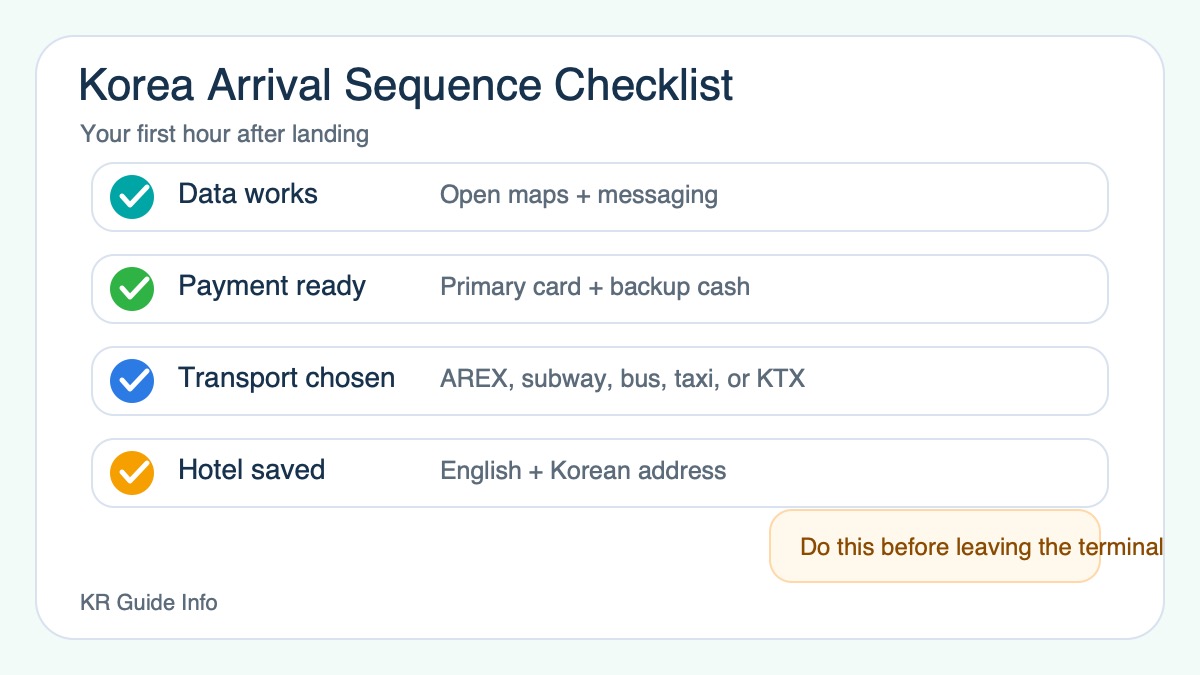
Arrival sequence that prevents most first-day problems
The first hour after landing is where many small mistakes start. Finish the basics before you leave the airport or major station area.
| Step | Check before moving on |
|---|---|
| Mobile data | Map search and messaging both work |
| Payment | Primary card, backup card, and small cash are separated |
| Transport | You know whether you need AREX, subway, bus, taxi, or KTX |
| Hotel | Address is saved in English and Korean if possible |
Related KR Guide Info guides
- Esim Vs Sim Card In Korea For Tourists
- Korea Sim Card Esim T Money Card Payment Guide
- Korea Hotel Check In Guide First Time Visitors
Plan the basic Korea travel setup next
After checking documents and arrival timing, these guides help with the everyday details that often decide whether the first two days feel smooth.
- 7-day Korea itinerary for first-time visitors — turn the checklist into a realistic day-by-day plan
- Best time to visit Korea by season — match packing and timing expectations to actual seasonal conditions
- Foreign card payments in Korea — prepare backup payment options before you leave
- Korea convenience store guide for travelers — know what you can solve quickly after arrival