Last checked: June 10, 2026
Quick answer
For most first-time visitors, a 7-day Korea itinerary works best when Seoul stays as the base and Busan or one major day trip is added carefully. Avoid packing every famous city into one week; the better trip has fewer transfers and more realistic evenings.
Why seven days works best with one main structure
Seven days is long enough to build rhythm and short enough that constant hotel moves can quietly damage the trip. That is why many first-time visitors do better with a Seoul-first plan plus one carefully chosen second-city or day-trip layer.
The goal is not to see “everything important.” The goal is to build a trip that actually feels good on the ground.
A practical seven-day shape that usually works
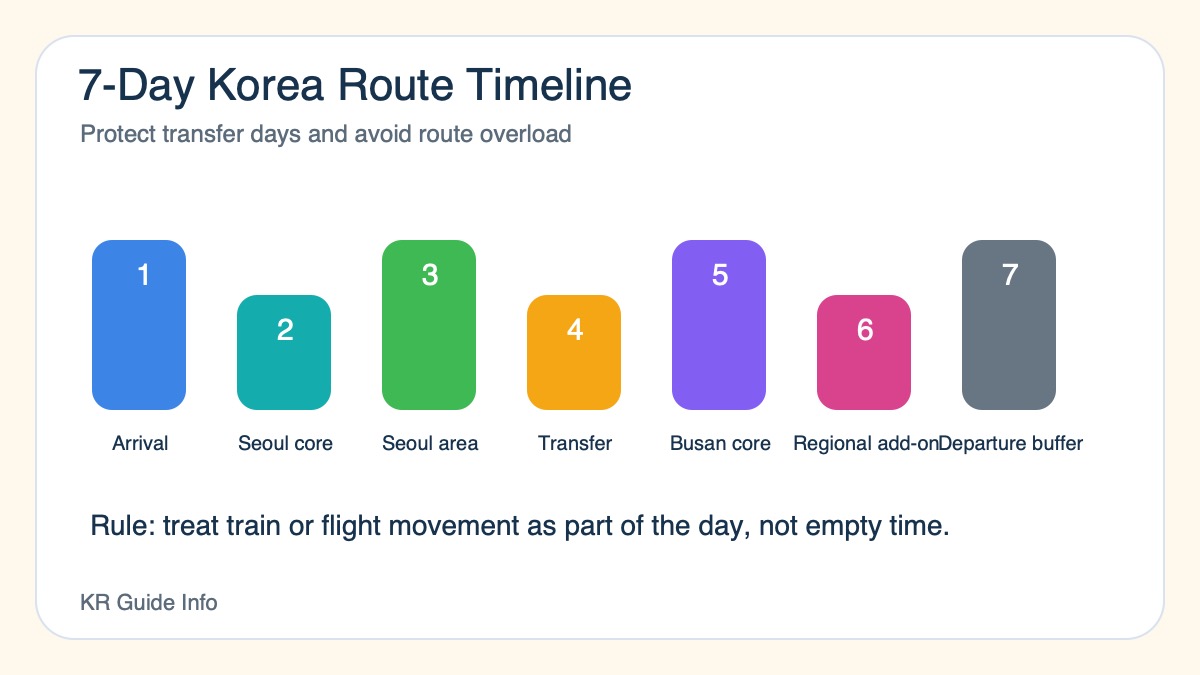
Most travelers do well with a structure like this:
- Day 1: arrival, hotel check-in, short neighborhood reset
- Day 2: central Seoul orientation day
- Day 3: one modern Seoul district and slower evening
- Day 4: another Seoul district or museum-focused day
- Day 5: transfer to Busan or keep Seoul as the only base
- Day 6: regional contrast day or one simple day trip
- Day 7: return, light final sightseeing, departure buffer
If your Seoul base is not decided yet, use the Seoul base guide before you finalize the structure.
When adding Busan improves the trip and when it does not
Busan works well when you want one meaningful contrast to Seoul and you are comfortable with one intercity transfer. It usually makes the trip stronger when you want a different city rhythm, coastal scenery, and a clear second base.
If you dislike checking out, moving luggage, and rebuilding your day after a train ride, a Seoul-based week may still be better. In other words, Busan is often worth it, but not automatically worth it.
If you are considering the second-city option, compare this plan with the Busan first-timer guide.
What makes a seven-day Korea trip feel rushed
The classic mistake is adding destinations simply because they are famous, not because they fit the actual route. Another mistake is underestimating how much energy transfers, stairs, weather, and check-in routines consume across a week.
Even in an efficient country, overpacking the itinerary usually makes the trip feel smaller, not richer. Korea rewards travelers who leave room for meals, movement, and slower neighborhood time.
The best planning rule for your first seven days
Build one strong week, not three small trips inside one week. If you let Seoul anchor the trip and add only the extension that clearly improves it, seven days is enough to make a first Korea visit feel genuinely satisfying.
A disciplined itinerary almost always beats an ambitious one.
How this advice fits into your overall Korea planning
7-Day Korea Itinerary for First-Time Visitors: A Practical First Trip Plan works best when you use it to make one or two major decisions early instead of collecting endless possibilities. Planning guidance is most valuable when it simplifies the route, the hotel base, or the first-day setup. Once one of those things becomes clearer, many other decisions become easier automatically.
What a realistic first-time traveler should optimize for
- Prioritize one strong hotel base over several weak hotel moves
- Leave room for meals, weather changes, and energy drops
- Use planning to remove uncertainty, not to create a rigid schedule
- Decide the trip structure before collecting too many attractions
Choose one seven-day route pattern
A seven-day first trip normally works better with two stable bases than with several one-night stops. Select the route according to arrival/departure airports and the experience you value most.
| Route pattern | Best fit | Main risk |
|---|---|---|
| Seoul only plus day trips | Travelers who dislike hotel moves | Using day trips that are too far to be comfortable |
| Seoul plus Busan | First visit with city and coast balance | Losing time by placing the KTX transfer in the middle of a busy day |
| Seoul plus Jeju | Nature/island priority | Flight and weather disruption inside a short trip |
| Open-jaw Seoul/Busan | Flights support different arrival/departure cities | Assuming the airfare and baggage terms are equivalent |
Count nights, not labels: an afternoon arrival and morning departure do not create full sightseeing days. Reserve the intercity segment early enough to protect the route, but keep one low-stakes block available for weather or fatigue.
Official sources
Related KR Guide Info guides
- First Time Korea Trip Planning Guide
- Best Day Trips From Seoul By Train
- First Time Busan Travel Guide
Update log
How KR Guide Info checked this guide
This guide was reviewed by the KR Guide Info editorial team for 7-day Korea itinerary planning. We checked Seoul-Busan pacing, transfer-day fatigue, first-trip route logic, and realistic city grouping, then added practical decision points for first-time foreign visitors rather than only listing places or features.
The safest 7-day Korea structure
A first 7-day Korea trip usually works best when you protect transfer days. Treat the train or flight between cities as part of the itinerary, not as empty time.
| Trip structure | Who it fits | Main risk |
|---|---|---|
| Seoul only | Travelers who want slower museums, cafés, shopping, and day trips | It can feel repetitive unless days are grouped by theme |
| Seoul + Busan | Most first-time visitors who want city contrast | Losing half a day if luggage and station timing are ignored |
| Seoul + Busan + Jeju | Fast travelers with strong flight planning | Too many transfers for a first Korea trip |
Related KR Guide Info guides
- First Time Korea Trip Planning Guide
- First Time Busan Travel Guide
- Busan To Gyeongju Day Trip Guide Foreign Visitors
Before you lock the 7-day route
A first Korea itinerary works better when the season, arrival basics, and daily payment expectations are already clear.
- Best time to visit Korea by season — choose a pace that fits weather and daylight
- Korea arrival checklist for first-time visitors — confirm documents, apps, and first-day setup
- Foreign card payments in Korea — avoid payment surprises during the trip